Showing posts with label pattern molded. Show all posts

Tuesday, January 14, 2020

Pitkin Glass Works Presentation for MoCG


Dana Charlton-Zarro and Annie, January 2020 Museum of Connecticut Glass meeting.
 This past weekend the Museum of Connecticut Glass held its annual meeting at Patriots Park in Coventry, Ct. Museum president Noel Tomas passed away last year, so there were a number of difficult decisions on the agenda. After a protracted business meeting, the museum board and members adjourned for a potluck lunch and a fascinating discussion of the Pitkin Glass Works by Tom Duff of Manchester and the Pitkin Queen herself, Dana Charlton-Zarro.

Tom Duff with a Pitkin flask.
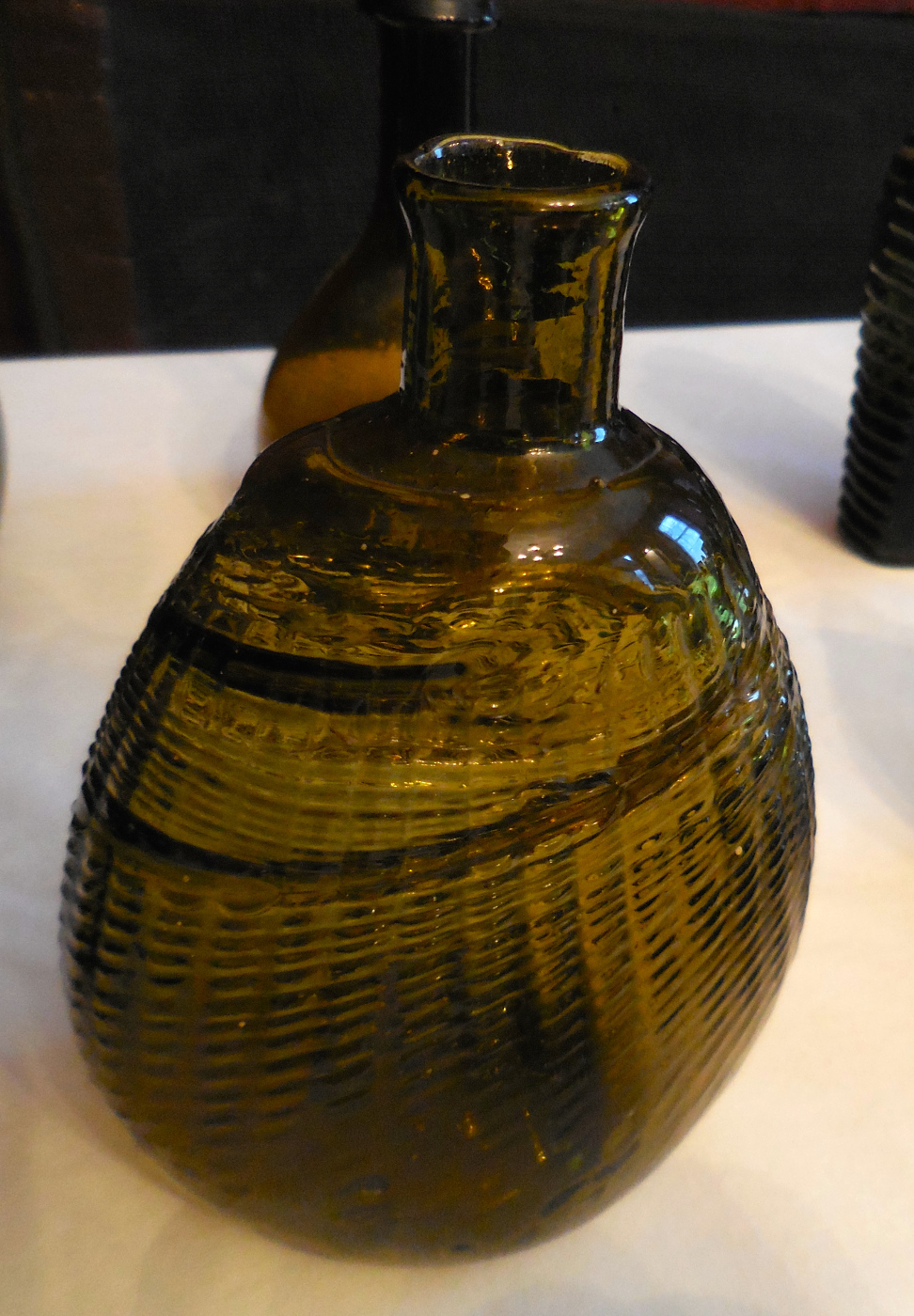
 The process of making a Pitkin-type flask was complex, involving double-dipping the initial bubble of glass (the "German half-post method" of bottle making), embossing ribs with a pattern mold, and twisting the bottle to shape the ribs into a helical swirl. One interesting point that came up in the discussion is that the swirl may have been introduced by rotating the bottle as it was being withdrawn from the pattern mold (as opposed to giving the bottle a sharp spin on the end of blowpipe after it was free of the mold, as I had heard in the past).

"Cross-swirled" Pitkin-type flask. 
 A "cross-swirled" flask was brought for display at the meeting. These flasks, with two sets of helical ribs swirled in opposite directions, are exceedingly rare, with probably fewer than half a dozen extant. It's not entirely clear how these were manufactured, but it probably involved even more skill than making the much more common single swirl or broken swirl (helix overlain by a set of plain vertical ribs) Pitkin flasks.

Pitkin-type flask from Poland. 
 Another oddity brought out for the presentation was a Pitkin-type flask from Poland. This continental flask was made by the German half-post method and has the broken-swirl pattern and basic flattened oval form often seen in New World Pitkin flasks, but is cruder and much thicker than is typical for Connecticut examples. Possibly it represents an ancestral form of this style of bottle, which was later refined and perfected by immigrant glassblowers working in America.

Sunburst flasks attributed to the Pitkin Glass Works: GVIII-5, GVIII-5a and GVIII-7, along with Pitkin-type flask and junk bottle/black glass wine bottle of the sort also made in early Connecticut glass works. 
Free blown, dip molded and pattern molded glass with very similar shapes and forms was made at many early American (and in some cases European) glass factories, so it is not really possible to associate a particular Pitkin-type flask with the actual Pitkin Glass Works. Mold-blown flasks, in contrast, leave behind distinctive shards in the archaeological record and can often be more or less definitively associated with a particular manufacturer (with the caveat that occasional stray shards from one factory could conceivably wind up at an unrelated factory site, perhaps brought in as cullet for recycling). Three different pint sunburst flasks are thought to be Pitkin products, with the GVIII-5 Pitkin sunburst in particular being firmly established by archaeological finds at the factory site in Manchester.


Saturday, September 16, 2017

Early Glass at the MoCG

Free blown and dip mold glassware in the Marshall collection.
 The September open house at the Museum of Connecticut Glass featured a display by Tom Marshall, who specializes in unusual and early free blown, dip molded and pattern molded glass, of the type that could have been made by the eighteenth and early nineteenth century glass works of Eastern Connecticut. Many Museum regulars turned out to admire some spectacular antique bottles and tableware, and there was also a slow but steady stream of visitors from the general public.

Crude free blown inkwell, bottles and tableware.

Pattern molded corner, with Pitkin-type flasks, inkwell, and an extremely rare Pitkin hat (likely a salt cellar, or possibly a whimsey).

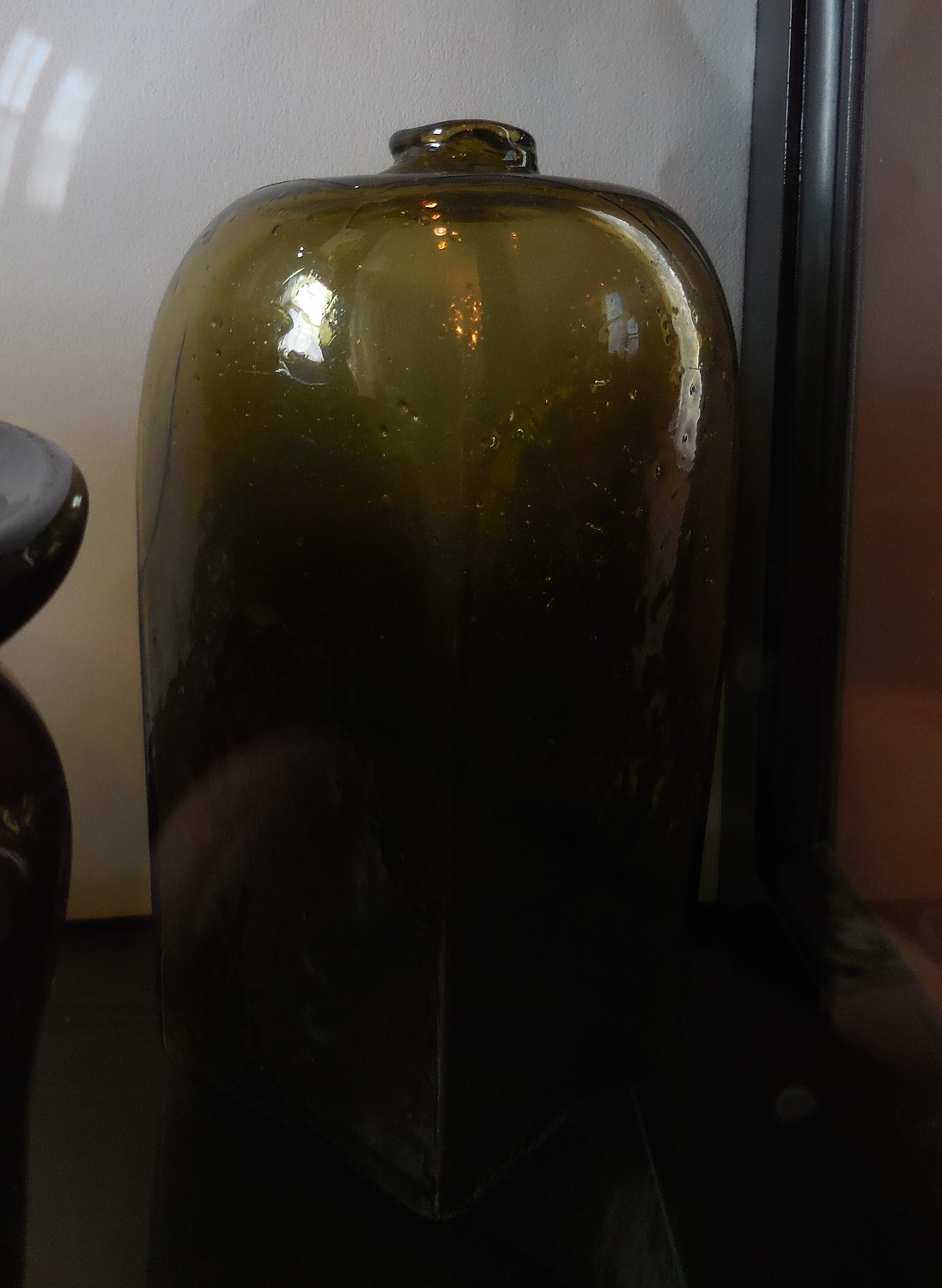
Early, flat-bottomed case-gin bottle whatzit with a plain sheared lip. Smaller than the common Continental case gins, in a more Connecticut-ish or New England-y glass color, with a very rare mouth treatment for this sort of bottle.

Large (baseball-sized) free blown inkwell.

"Coventry Glass Works" sign, likely not period.
Aside from the special glass from Tom Marshall, the Museum had a recent acquisition on display: a large blue painted wooden sign reading "Coventry Glass Works." This doesn't look all that old to me; it's pretty clean and the blocky sans-serif lettering looks kind of modern. Others who have examined the sign are also of the opinion that it's a twentieth century fantasy reproduction, not something that was ever hung outside the factory 200 years ago. Apparently a similar (also possibly not authentic) sign exists for the Willington Glass Co., in a private collection in the area.

Sunday, June 25, 2017

Pitkin Flask Display

Pitkin-type flask display at the Museum of Connecticut Glass. June 17, 2017.
The June open house at the Museum of Connecticut Glass hosted a unique display of about 30 Pitkin-type flasks, plus some related bottles and inkwells. Dana Charlton-Zarro, a well-regarded specialist in this style of early American glass, was kind enough to bring up a portion of her fabulous collection for the open house, and to stay around to share her extensive knowledge of the bottles.

Dana's collection focuses on New England Pitkin-type flasks, many of which were indeed made at the Pitkin Glass Works, though more or less identical bottles were produced by the Coventry, Mather, Glastenbury and probably Willington glass factories in Connecticut, as well as in New Hampshire factories. Glassware in the same general style was produced in Mid Atlantic and Midwestern glass works, though the forms, colors and rib counts of New England Pitkins seem to be fairly distinctive.

The process of blowing Pitkin-type flasks was complex and required multiple steps executed by a skilled craftsman. Various modern glass studios, including Pairpoint on Cape Cod, have attempted to recreate New England Pitkins, though the delicate patterns and eggshell-thin glass of better antique flasks seems to be very difficult to replicate. At some point, probably around 1820, Pitkin-type flasks went out of production, replaced by sunburst flasks and other styles of embossed bottles blown in two part metal molds, in a much less technically demanding procedure.

Dana Charlton-Zarro (with flask) explains the finer points of Pitkin-type flasks to some Museum visitors.

The gaffer had some difficulties with this bottle: some sections of the sides got folded over and stuck to themselves during the blowing process.

Some smaller Pitkin flasks, between four and five inches tall. Pitkins below five inches tall (or more than seven inches) are relatively rare.

Pitkin type inkwells. The squared-off example (center left) was probably expanded in a dip mold for snuffs, and was recovered from a Connecticut stream bank relatively recently. The "cross-swirled" example (center right), with ribs curved to the left and to the right, is also very rare.

Some more special Pitkins: pint and half-pint examples in a blue-green color, with barely any hint of olive (the color is more blue in person), and a greenish, wide, flattened bottle with very tight ribbing.


Sunday, May 21, 2017

Museum of Connecticut Glass 2017

Center of the National Historic Glass Factory District in Coventry, Ct: the old University of Connecticut agricultural experiment barn, the Capt. John Turner house (both MoCG property) and the Nathaniel Root house.

 The Museum of Connecticut Glass started their 2017 schedule of public events with the annual antique glass and bottle show. Tours were also offered of the John Turner house, which was built ca. 1812-1813 by one of the incorporators of the Coventry Glass Works.

The sales field at the Coventry glass show, May 20, 2017.
  In spite of some cool, cloudy weather with a few drops of rain for the first half of the show, there was a great selection of glass up for sale, and a decent turnout of buyers, though it possibly wasn't as busy as some other Coventry shows in recent years. There was a conflict with another area glass sale, which probably didn't help, at least from the seller's point of view.

Stoneware, case bottles and more on offer.

Some of the good stuff: Willington, Westford and New London flasks.

A Coventry DEWITT CLINTON / LAFAYETTE half pint historical flask, GI-81.

There weren't many New England Pitkin flasks available at the show this year, but in June there will be a chance to check out one of the best collections of Pitkin flasks anywhere...

Connecticut or New England Pitkin-type flasks. 

Next month's Museum activity will be a display of Pitkin-type flasks and related early American glass, with expert Dana Charlton-Zarro on hand to share her knowledge of the subject. This will, I believe, be the first time that Dana has traveled to the Pitkin homeland in Connecticut to give a public talk about her favorite antique bottles, and it should be a special opportunity to see and learn about a beautiful and widely admired class of early glassware. The Pitkin display will be held Saturday, June 17, 1:00-4:00 at the Museum of Connecticut Glass.

Future MoCG open houses will be held the third Saturday of each month, 1:00-4:00, through the autumn. Special exhibits will include:
July 15 - Victorian glass tableware manufacture in Connecticut, with Nick Wrobleski (tentative).
• August 19 - Coventry Glass Works flasks and other antique Connecticut blown-in-mold glass.
• September 16 - early Connecticut freeblown and pattern-molded tableware, whimsies and other rarities, with Tom Marshall.
• October 21 - TBA.

Sunday, April 17, 2016

Museum of Connecticut Glass Season Opener

The John Turner House.
 The Museum of Connecticut Glass started its 2016 season of open houses this weekend, with tours of the ca. 1813 house of John Turner, one of the incorporators of the Coventry Glass Works. The temperatures were a bit cool, especially inside of the Turner house, with its massive double-layered brick walls and dearth of windows on the south side, but the weather was clear and bright and turnout was good.
The MCG barn, with guests arriving.
 The guests included some locals who saw the "open" signs and were curious, and also people who had traveled specifically to see the Museum. One fellow was an antique building specialist who was more interested in the Turner house itself than Connecticut glass; he was absolutely ecstatic to see that the structure had been stabilized, but was otherwise in mostly unrenovated condition, with 200 years of modifications and a lot of well-used grunginess. Visitors like seeing the house, but that sort of deep enthusiasm was something I hadn't encountered before.

Display of early bottles, of the kind made at the Pitkin Glass Works. L-R: black glass wine bottle, chestnut bottle, Pitkin-type flask, GVIII-7 pint sunburst flask, dip molded snuff bottle.
The display this month was glass connected with the Pitkin, Coventry and Willington glass factories, along with the more permanent collections of memorabilia and excavated shards from Coventry, and a small exhibit on the Meriden Flint Glass Company. The next open house will be May 21, 2016, in association with the Museum's annual tailgate-style bottle and glass sale. 

Monday, October 26, 2015

Heckler's Autumn Auctions

Norman C. Heckler & Co., October 2015.
The Norman C. Heckler & Co. auction house recently held one of their very occasional invitation-only live auctions. It was a beautiful autumn day for it, a bit on the cool side but with plenty of sun. It was peak fall foliage season for the sugar maples around the historic farm where Heckler's is located.

Norman Heckler Sr. lays down the law on auction rules.
The turnout at the auction was pretty high, with maybe 60-70 bidders. I'm not sure what the criteria for getting an invitation were, but I suspect it was more or less "had registered for a live auction within the past couple of years." The format was similar to other live auctions I've attended, with about 130 lots, ranging from giant table lots of flea market fodder to single bottles. Most lots probably went for a couple of hundred dollars, with one large group of 19th century soda bottles fetching about $1700. 

GII-62 Willington Glass Co. eagle, pint flask.
The selection of old Connecticut glass was a bit limited compared to typical Heckler sales. There were several different Willington eagle flasks, including the nice GII-62 above, which was tempting. The Pitkin-type flask below was an odd one, described as Midwestern by the auctioneers because of the color and relatively rounded, broad shoulders. The overall tall, skinny oval form is a little suggestive of New England Pitkins, however, with Midwestern examples tending to be closer to round. It's also worth noting that there is good evidence from glass works excavations and the distribution of 20th century bottle finds that what collectors call "Midwestern Pitkins" actually were made at very early Mid-Atlantic factories. In any case, this was a lovely old bottle that went for not much money, because of a faint crack in the lip.

Pitkin-type flask, 32 ribs, swirled to the right, pint size, 6 3/4 inches tall.
Heckler's absentee auction preview shed.
Heckler's also had their November absentee auction up for preview. This will be one of their "select" auctions, with bottles that are nice, but generally not quite as fancy as would wind up in a "premier" auction. There were some good items from Connecticut glass houses, as well as some Connecticut/New England items that are difficult to pin down to a specific origin, like a pair of small Pitkin-type flasks, one with very well-defined ribbing and one with very soft, fuzzy pattern-molding. There is an especially large selection of Coventry Glass Works flasks with bolder impressions than are usually seen from their respective molds.

GII-70 Coventry Glass Works eagle pint, in the upcoming autumn absentee auction, as are all the other bottles pictured in the rest of this post.
GI-85 "LaFayette/Covetry/C-T"; liberty cap pint flask.
GV-6 "Success to the Rail Road" Coventry pint flask.
GV-10 "Railroad Lowell" Coventry half-pint flask.
Reversed "Patent" electrical insulator, probably Willington Glass Co.

Tuesday, September 15, 2015

Pitkin Display at the Old Manchester Museum

Pitkin-type flask, decanter and utility bottles possibly made at the Pitkin Glass Works.
 The Old Manchester Museum, located on Cedar Street in Manchester Connecticut, is home to quite a nice educational display dealing with the Pitkin Glass Works. It includes bottles that are attributed with varying degrees of certainty to Pitkin, as well as associated artifacts, photographs, modern commemorative items and paintings, all labelled with useful explanations and donor information.

The Museum building.
 The Old Manchester Museum is operated by the Manchester Historical Society, and is currently open only one afternoon per month, on the second Sunday, although school group tours occur at other times and it is possible to arrange for special access. Exhibits include areas focusing on town schools, local sports figures, Bon Ami soap (based for a time in Manchester), the once extensive silk industry, quarries and dinosaur fossils, and the Spencer Repeating Rifle, the world's first practical multi-shot rifle, which was invented in Manchester and proved instrumental in winning the Civil War for the Union. All of this was informative, but I was mainly there for the Pitkin display.

The Museum has the massive iron lock to the glass factory door.

A free blown demijohn, 2-3 gallon capacity, donated in 1991 by Hazel Cooper. According to Cooper, this bottle was blown at the Pitkin Glass Works and passed down by descendants of the Pitkin family.

A "J.P.F." mold-blown inkwell, known from archaeological evidence to be a Pitkin product.

A miniature free blown chestnut flask, 1.8 inches high, side and bottom views. This flask was excavated by middle school students working with Connecticut State Archaeologist Nick Bellantoni at the Pitkin ruins, on May 14, 2003. This is truly a unique item, both in terms of its tiny size and impeccable Pitkin attribution. It also seems to be extremely unusual to find intact glassware actually on the site of an old glass factory. A 2012 article in the Manchester Journal Inquirer recounts collectors at the time of the dig offering $5,000, and then $20,000, for this odd little bottle, which has fortunately remained on public display.

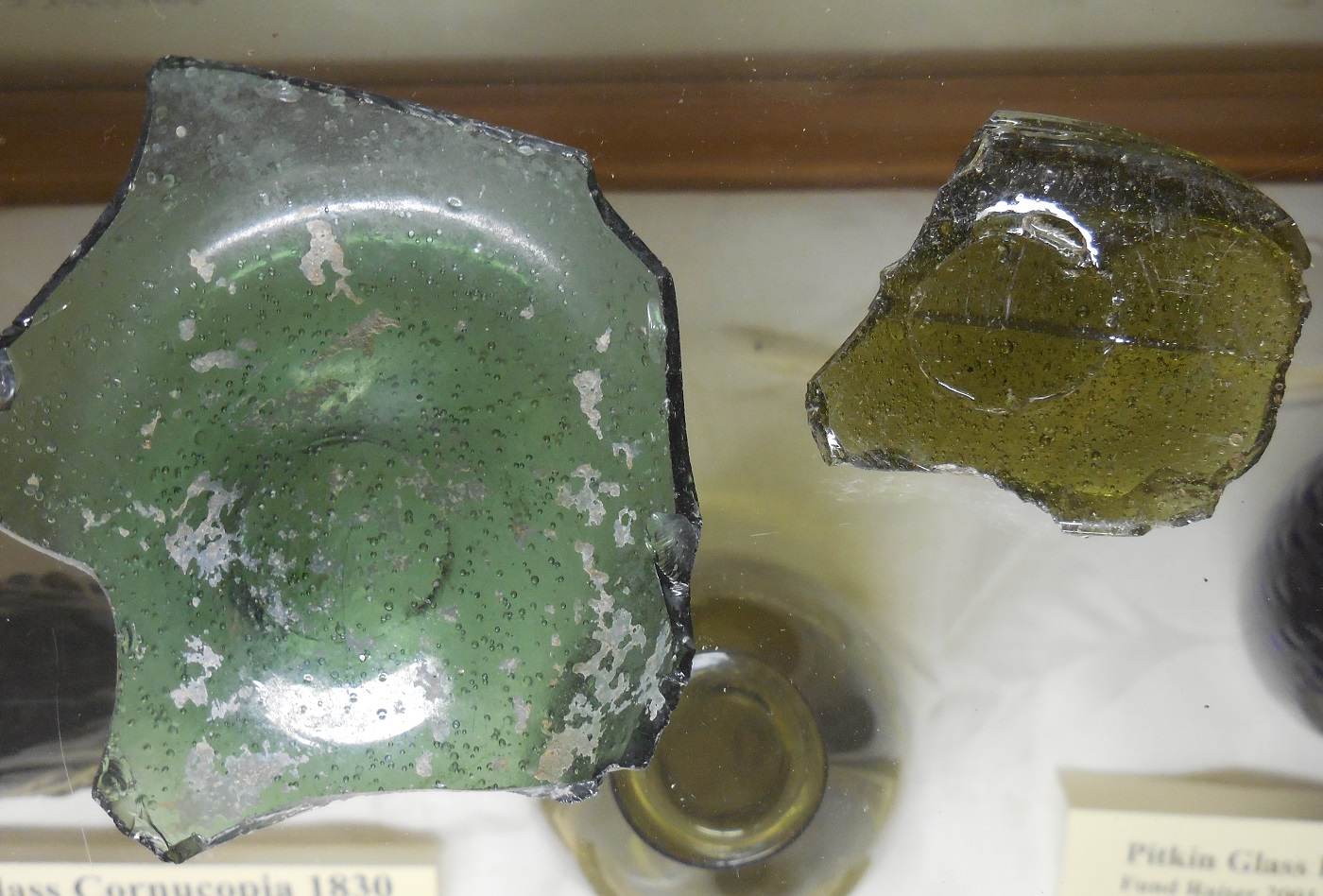
Some shards from the Pitkin Glass Works site, with the pontiled base of a big free blown bottle in light blue-green, almost aquamarine, glass at left, and the base of an olive-green figured flask at right. The figured flask fragment included just a few non-distinctive portions of ribbed sides, and could be from any of a number of molds, such as one of the pint Pitkin sunbursts.

Photographs of archaeological digs at the Pitkin site, with images of the miniature chestnut flask in situ.

Early 20th century photograph of children playing on the Pitkin ruins, by John Knoll (1887-1955).

1965 oil painting of the Pitkin Glass Works by Nora Addy Drake, who also painted the (charmingly weird) murals at the nearby Shady Glen cheeseburger and milkshake joints.
 Admission to the Old Manchester Museum is by donation ($5 suggested). It's well worth a trip if you can catch the Museum during its open hours, particularly if you are interested in the rich lore surrounding what is perhaps America's most storied early glass factory.


Sunday, June 21, 2015

Museum of Connecticut Glass Open House

Free blown and dip mold New England glass.

 The Museum of Connecticut Glass held one of its monthly open houses this weekend. The Museum has a very limited, all-volunteer staff, but they are trying to have regular public educational events and shows during the warmer months. The main event for June was a spectacular display of early glassware and bottles from the collection of Tom Marshal. Tom has been acquiring his glass since the 1980s, and focuses on primitive free blown bottles and tableware, particularly forms and colors that can be associated with Connecticut, or at least the general New England area. Many of these objects are quite unusual and rare, and it was a treat to see so many in one place. Tom and other Museum volunteers gave informative talks about antique glass and glassmaking, and there was also a bottle sales area set up to benefit the Museum.


Bruce Mitchell and Alan Lagocki talk about glass making and early glass factories in Connecticut in the Museum's barn display area. The famous $3 bottle tables are by the window, with some real bargains to be had.

More of Tom Marshal's pre-1840 Connecticut-ish tableware, utilities and unique "end-of-day" items, in the kitchen window of the Capt. John Turner house.


A small display of later 19th and early 20th Century decorative glass, mostly made by the Meriden Flint Glass Company, from Bruce Mitchell's collection.

Freeblown and pattern molded inkwells, attributable to the Pitkin Glass Works or possibly other contemporaneous Connecticut factories. The "Pitkin hat" at left is a bit cracked, but one of the few known examples of an exceedingly rare and desirable end-of-day type item.