Showing posts with label demijohn. Show all posts

Tuesday, September 15, 2015

Pitkin Display at the Old Manchester Museum

Pitkin-type flask, decanter and utility bottles possibly made at the Pitkin Glass Works.
 The Old Manchester Museum, located on Cedar Street in Manchester Connecticut, is home to quite a nice educational display dealing with the Pitkin Glass Works. It includes bottles that are attributed with varying degrees of certainty to Pitkin, as well as associated artifacts, photographs, modern commemorative items and paintings, all labelled with useful explanations and donor information.

The Museum building.
 The Old Manchester Museum is operated by the Manchester Historical Society, and is currently open only one afternoon per month, on the second Sunday, although school group tours occur at other times and it is possible to arrange for special access. Exhibits include areas focusing on town schools, local sports figures, Bon Ami soap (based for a time in Manchester), the once extensive silk industry, quarries and dinosaur fossils, and the Spencer Repeating Rifle, the world's first practical multi-shot rifle, which was invented in Manchester and proved instrumental in winning the Civil War for the Union. All of this was informative, but I was mainly there for the Pitkin display.

The Museum has the massive iron lock to the glass factory door.

A free blown demijohn, 2-3 gallon capacity, donated in 1991 by Hazel Cooper. According to Cooper, this bottle was blown at the Pitkin Glass Works and passed down by descendants of the Pitkin family.

A "J.P.F." mold-blown inkwell, known from archaeological evidence to be a Pitkin product.

A miniature free blown chestnut flask, 1.8 inches high, side and bottom views. This flask was excavated by middle school students working with Connecticut State Archaeologist Nick Bellantoni at the Pitkin ruins, on May 14, 2003. This is truly a unique item, both in terms of its tiny size and impeccable Pitkin attribution. It also seems to be extremely unusual to find intact glassware actually on the site of an old glass factory. A 2012 article in the Manchester Journal Inquirer recounts collectors at the time of the dig offering $5,000, and then $20,000, for this odd little bottle, which has fortunately remained on public display.

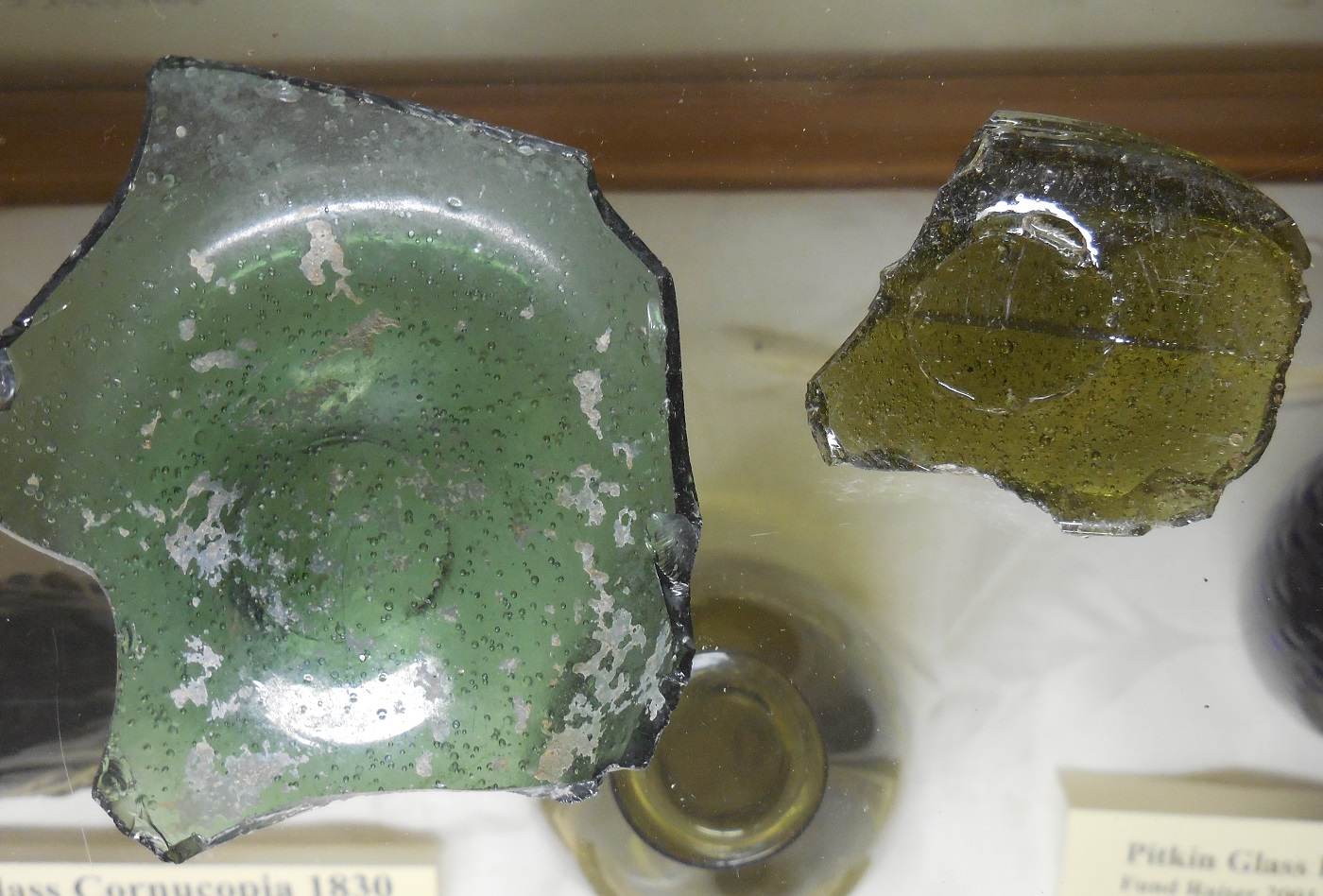
Some shards from the Pitkin Glass Works site, with the pontiled base of a big free blown bottle in light blue-green, almost aquamarine, glass at left, and the base of an olive-green figured flask at right. The figured flask fragment included just a few non-distinctive portions of ribbed sides, and could be from any of a number of molds, such as one of the pint Pitkin sunbursts.

Photographs of archaeological digs at the Pitkin site, with images of the miniature chestnut flask in situ.

Early 20th century photograph of children playing on the Pitkin ruins, by John Knoll (1887-1955).

1965 oil painting of the Pitkin Glass Works by Nora Addy Drake, who also painted the (charmingly weird) murals at the nearby Shady Glen cheeseburger and milkshake joints.
 Admission to the Old Manchester Museum is by donation ($5 suggested). It's well worth a trip if you can catch the Museum during its open hours, particularly if you are interested in the rich lore surrounding what is perhaps America's most storied early glass factory.


Sunday, August 16, 2015

Museum of Connecticut Glass August Open House

Set of the three sizes of Willington pickle bottles.
 This weekend there was another open house at the Museum of Connecticut Glass in Coventry. The weather was hot, sunny and humid, and this time of year half of the local population is probably on vacation at some mountain lake or Cape Cod beach house, so attendance was apparently down from previous events. Still, there was a pretty steady flow of visitors through the Museum.

Me in the Captain John Turner house, with some of the displays.
 The displays this time included figured flasks and other glass from eastern Connecticut glass works, with quite a few Coventry flasks that were of special interest to some of the neighbors of the Museum who stopped in at one point. The exhibit area in the Turner house stayed pleasantly cool for most of the day; the brick walls were constructed in an old English style and are very thick, so the building takes some time to heat up even on a sunny mid-August day.

Amber utility bottles: the whiskey cylinder (middle left) is embossed "Willington Glass Works," the demijohns and beer bottle are in the style of Willington glass, but could be from Westford or elsewhere in New England.
The Willington Glass Company had an extraordinarily long run, from 1815 to 1872, so it is somewhat surprising that the types of glassware that can be attributed to Willington with any degree of confidence are quite limited, and mostly date to the final 20-30 years of the company's operations. There are the well-known square cathedral pickle bottles, a couple of base-embossed cylindrical whiskey bottles, some late figured flasks with simplistic eagle designs, an electrical insulator, one variant of a sarsaparilla bottle, as well as paneled blueberry bottles and a few other styles of utilities that are generally associated with Willington. That's about it, aside from a few individual items linked to Willington by family tradition, for whatever that's worth. It seems as if for much of the history of the factory, production was dominated by generic unmarked demijohns, snuff bottles, beers, flasks etc., of types that could also have easily been made at any of a number of other New England glass works. It would be interesting if future archaeological investigations at the site could find evidence of other distinctive Willington products; one wonders if some of the early, pre-1840 figured flasks of unknown origin might have been made there. 

Sunday, July 19, 2015

Westford Bottles Auctioned

Norman C. Heckler & Co.
Norman C. Heckler & Company, in Woodstock, Connecticut, is the specialist auction house most closely associated with glass from the Quiet Corner, because of geography and the expertise of the company's founder. This summer, Heckler's is liquidating the collection of Ralph Fletcher, a specialist in the Westford Glass Company and also owner of the property that includes the site of the glass works in Westford (a village in Ashford, Ct). There are a bunch of Westford pieces being offered in the current online Heckler's auction, and more coming up in future sales. Here are a few highlights.

GXIII-37 half pint sheaf-of-wheat / "Westford Glass Co Westford Conn" flask. A common flask, but almost unheard of with a sheared lip rather than a tooled applied collar.

Demijohn blown in a three piece mold with a beveled base, a form associated with the Westford Glass Co. The colors of glass produced at Westford are overwhelmingly dominated by amber, so this blue-green example is unusual, possibly suggesting that this particular bottle was made at the Willington Glass Co., which made a broader range of colors (in addition to also making a whole lot of murky dark amber glass).

Free blown flask with sheared lip and sheared or pontiled base. Made of very heavy, dark olive amber glass and attributed to Westford by Fletcher.

"Geo. W. Hoxsie's Premium Beer" bottles are generally thought to have been manufactured at Westford. 

More dark amber beer bottles, cylinder whiskey bottles and demijohns in styles and colors that are linked to Westford. These less valuable bottles are to be sold at Heckler's August live auction. 
A case of unembossed Hoxsie-style beer bottles, also maybe of Westford origin and destined for the August live auction.