Showing posts with label archaeology. Show all posts

Wednesday, February 3, 2016

John Mather House

John Mather's house, January 2016
John Mather, of the Parker Village area of Manchester (formerly East Hartford), Connecticut, was an early nineteenth century merchant and manufacturer of gunpowder and glass. The Mather Glass Works have been an object of speculation among students of early American glass for some time; they were long known only from period advertisements and brief newspaper articles. John Mather's 1827 house still stands on Mather Street, close to the site of his glass factory, though the factory seems to have ceased operations about six years before the house was built.

The area around Mather's house and its small corner plot of land was subject to intense suburban residential and industrial development in the mid-twentieth century, and any above-ground remains of the glass works that might have existed at the time were apparently bulldozed. My own preliminary investigations of the site have turned up period glass, bricks, furnace lining and other typical glass factory waste beneath some of the back yards in the neighborhood. The shards that have turned up indicate that Mather's factory made typical New England free blown, dip molded and pattern molded glassware, but so far there has been no indication of the production of historical flasks or other glass blown in more advanced two part metal molds. 

John Mather's house in a painting by Russell Cheney (1881-1945) that hangs in the Manchester Masonic Temple. Note that the giant white oak on the corner has hardly changed in the past 70 years or more. Photo via the Manchester Historical Society.

Pitkin Glass Works ruins, January 2016
The famous Pitkin Glass Works ruins are located less than two miles south of Mather's house, but have been preserved and stabilized, and are generally much more thoroughly studied and understood than the Mather Glass Works. This spring, when the weather warms up, I hope to get back to some of the properties on Mather Street where I have received permission to excavate shards, and eventually gather enough material to write up a more formal description of the likely products of the glass works there.

Tuesday, September 15, 2015

Pitkin Display at the Old Manchester Museum

Pitkin-type flask, decanter and utility bottles possibly made at the Pitkin Glass Works.
 The Old Manchester Museum, located on Cedar Street in Manchester Connecticut, is home to quite a nice educational display dealing with the Pitkin Glass Works. It includes bottles that are attributed with varying degrees of certainty to Pitkin, as well as associated artifacts, photographs, modern commemorative items and paintings, all labelled with useful explanations and donor information.

The Museum building.
 The Old Manchester Museum is operated by the Manchester Historical Society, and is currently open only one afternoon per month, on the second Sunday, although school group tours occur at other times and it is possible to arrange for special access. Exhibits include areas focusing on town schools, local sports figures, Bon Ami soap (based for a time in Manchester), the once extensive silk industry, quarries and dinosaur fossils, and the Spencer Repeating Rifle, the world's first practical multi-shot rifle, which was invented in Manchester and proved instrumental in winning the Civil War for the Union. All of this was informative, but I was mainly there for the Pitkin display.

The Museum has the massive iron lock to the glass factory door.

A free blown demijohn, 2-3 gallon capacity, donated in 1991 by Hazel Cooper. According to Cooper, this bottle was blown at the Pitkin Glass Works and passed down by descendants of the Pitkin family.

A "J.P.F." mold-blown inkwell, known from archaeological evidence to be a Pitkin product.

A miniature free blown chestnut flask, 1.8 inches high, side and bottom views. This flask was excavated by middle school students working with Connecticut State Archaeologist Nick Bellantoni at the Pitkin ruins, on May 14, 2003. This is truly a unique item, both in terms of its tiny size and impeccable Pitkin attribution. It also seems to be extremely unusual to find intact glassware actually on the site of an old glass factory. A 2012 article in the Manchester Journal Inquirer recounts collectors at the time of the dig offering $5,000, and then $20,000, for this odd little bottle, which has fortunately remained on public display.

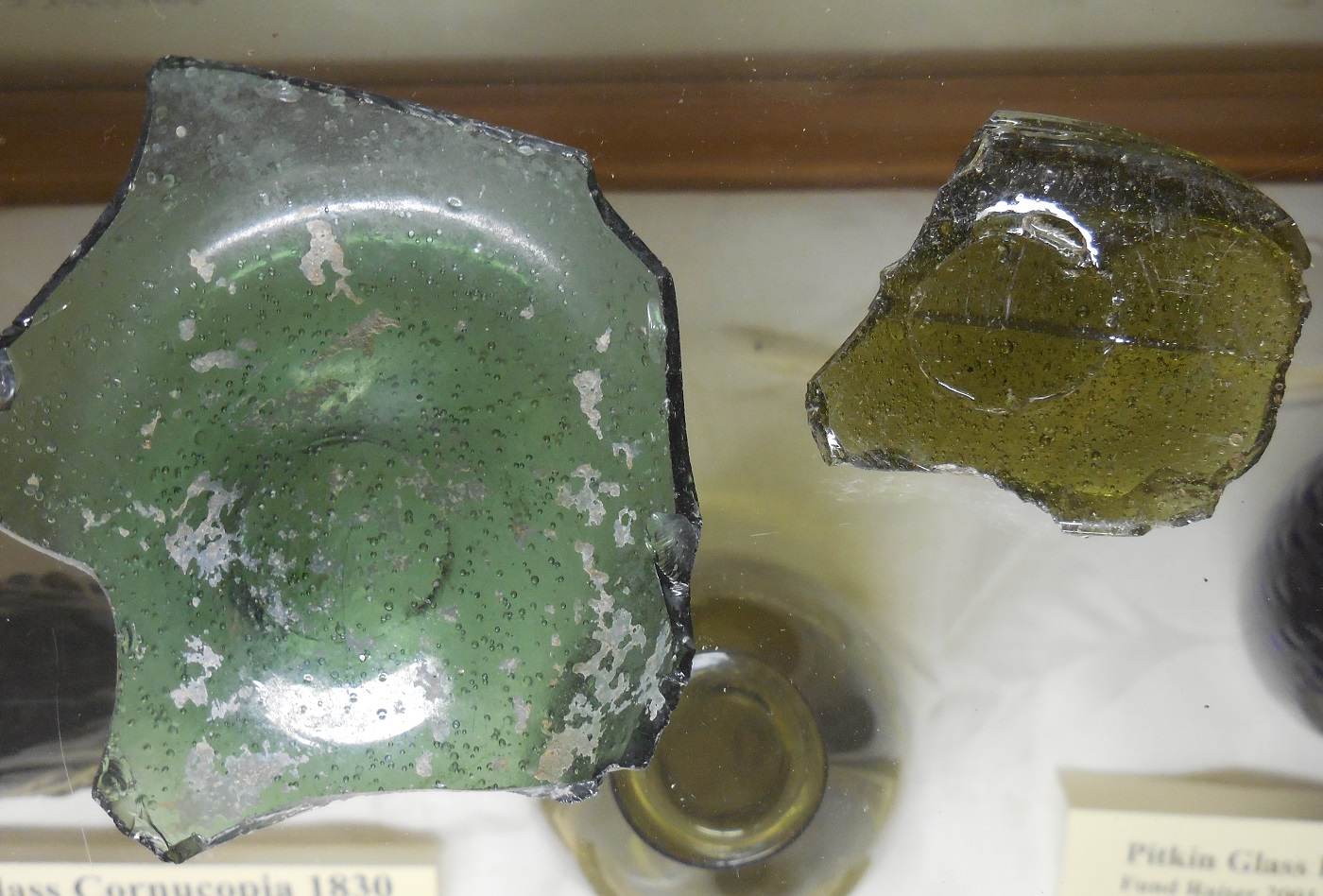
Some shards from the Pitkin Glass Works site, with the pontiled base of a big free blown bottle in light blue-green, almost aquamarine, glass at left, and the base of an olive-green figured flask at right. The figured flask fragment included just a few non-distinctive portions of ribbed sides, and could be from any of a number of molds, such as one of the pint Pitkin sunbursts.

Photographs of archaeological digs at the Pitkin site, with images of the miniature chestnut flask in situ.

Early 20th century photograph of children playing on the Pitkin ruins, by John Knoll (1887-1955).

1965 oil painting of the Pitkin Glass Works by Nora Addy Drake, who also painted the (charmingly weird) murals at the nearby Shady Glen cheeseburger and milkshake joints.
 Admission to the Old Manchester Museum is by donation ($5 suggested). It's well worth a trip if you can catch the Museum during its open hours, particularly if you are interested in the rich lore surrounding what is perhaps America's most storied early glass factory.


Sunday, June 14, 2015

Awesome Seventeen-Eighties Work Escape Wayback Weekend

The Pitkin Glass Works ruins.
 The 1783~1830 Pitkin Glass Works ruins were open to the public this weekend, in conjunction with Manchester Pride Week and the Connecticut tourism open house day. It was a rare chance to see the ruins up close, although they are located in a residential neighborhood and can be viewed from the street over a fence at any time. The Pitkin factory is the oldest of Connecticut's glass works, and also, by some fluke of history, the only early Connecticut glass factory where significant portions of the factory building itself are still standing (there are still some visible foundations at the site of the Westford Glass Company, but all of the other factories have been completely leveled).

Waste glass drips and broken bottles in a bald spot in the lawn on the Pitkin grounds. The glass is mostly olive-green-amber, but notice the two light blue-green shards at center, examples of an uncommon but legitimate Pitkin color.
Even on the surface of the soil around the ruins there are occasional pieces of glass and other factory waste. Early glass works were pretty messy affairs, apparently, and Pitkin debris can be found all around the area. Several neighbors stopped in during the open house to talk to the staff of the Manchester Historical Society and donate pieces of glass that they had unearthed when gardening or having old oil tanks removed.

Excavations inside the walls of the factory ruins, with some possible foundation stones exposed.
A number of archaeological digs have been conducted at the Pitkin Glass Works, including extensive investigations by Fredrick Warner and his students from Central Connecticut State University in 1984 (summarized in A History of the Pitkin Glass Works by William E. Buckley), as well as more recent and ongoing excavations carried out by Manchester middle school students.

Stones and old bricks exposed by school group excavations.
The walls of the Pitkin factory building are primarily made of grey gneiss. The local bedrock in most of Manchester is Triassic sedimentary "red beds" and basalt, so construction materials were probably carted in, perhaps from the quarries at Bolton Notch, east of Manchester.

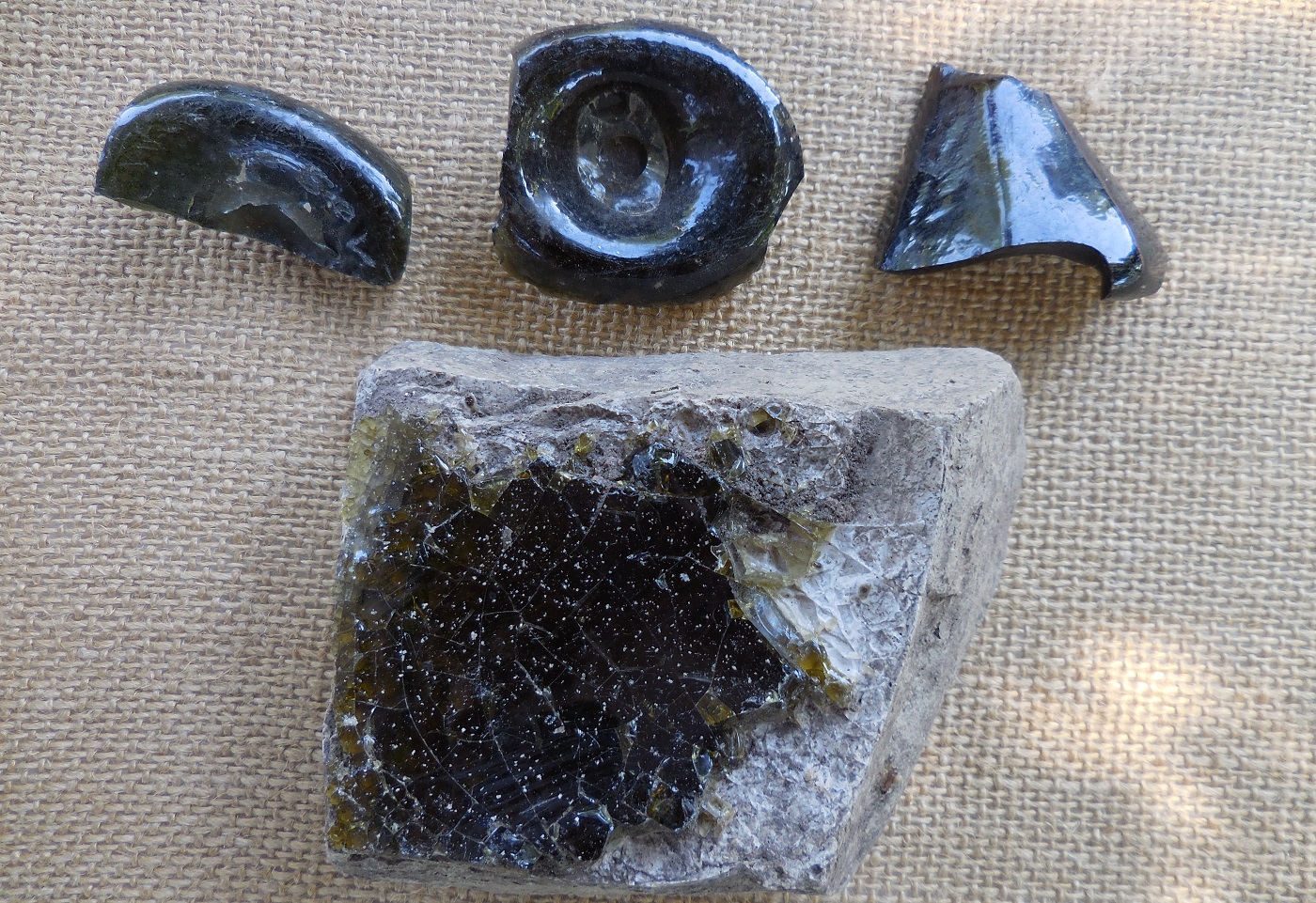
Artifacts excavated at the Pitkin site by Tom Duff. Two pontiled bases of Pitkin-type pattern molded flasks in olive green; the side of an umbrella inkwell in dark olive amber; and a large fragment of a ceramic pot for melting glass.
Archaeological excavations at glass factory sites provide some of the strongest evidence for attributing particular products to a given glass works. Pitkin-type flasks, with swirled or broken swirl pattern-molded embossings and blown in the German half-post method, are indeed fairly abundantly represented among shards from the Pitkin Glass Works. Extremely similar flasks were also blown at other contemporaneous New England glass works, however. Tom Duff has an interesting shard in his collection of Pitkin materials, picked up near the ruins many years ago, that is clearly from a Coventry Lafayette figured flask. Glass factories incorporate old broken glass, or cullet, into new batches to hasten melting, so the Lafayette shard was probably left behind from a pile of broken bottles collected from the community for recycling. Care must be taken when interpreting finds from factory sites; clear patterns certainly emerge and provide solid links between certain types of bottles and certain factories where multiple fragments of those bottles have been recovered, but odd one-off shards could be misleading.

Tom Duff's display of glass factory tools and New England bottles representative of the likely products of the Pitkin Glass Works.
Representatives of the Manchester Historical Society and the Pitkin Glass Works organization were on hand to answer questions, with displays of bottles and other artifacts. Tom Duff brought in Pitkin-type flasks and inkwells, as well as figured flasks, case gin bottles and other glassware typical of the goods that were likely produced by Pitkin. He also had blow pipes and other glass house tools, including a ribbed iron mold used to make pattern molded glass, along with a modern teal-colored Pitkin-type flask blown in his mold by Pairpoint Glass on Cape Cod. The 32 rib mold was recovered from a warehouse in New Jersey, but could conceivably be an eighteenth or early nineteenth century antique from New England.