|
| Pitkin-type flask, decanter and utility bottles possibly made at the Pitkin Glass Works. |
The
Old Manchester Museum, located on Cedar Street in Manchester Connecticut, is home to quite a nice educational display dealing with the Pitkin Glass Works. It includes bottles that are attributed with varying degrees of certainty to Pitkin, as well as associated artifacts, photographs, modern commemorative items and paintings, all labelled with useful explanations and donor information.
 |
| The Museum building. |
The Old Manchester Museum is operated by the Manchester Historical Society, and is currently open only one afternoon per month, on the second Sunday, although school group tours occur at other times and it is possible to arrange for special access. Exhibits include areas focusing on town schools, local sports figures, Bon Ami soap (based for a time in Manchester), the once extensive silk industry, quarries and dinosaur fossils, and the Spencer Repeating Rifle, the world's first practical multi-shot rifle, which was invented in Manchester and proved instrumental in winning the Civil War for the Union. All of this was informative, but I was mainly there for the Pitkin display.
 |
| The Museum has the massive iron lock to the glass factory door. |
 |
| A free blown demijohn, 2-3 gallon capacity, donated in 1991 by Hazel Cooper. According to Cooper, this bottle was blown at the Pitkin Glass Works and passed down by descendants of the Pitkin family. |
 |
| A "J.P.F." mold-blown inkwell, known from archaeological evidence to be a Pitkin product. |
 |
| A miniature free blown chestnut flask, 1.8 inches high, side and bottom views. This flask was excavated by middle school students working with Connecticut State Archaeologist Nick Bellantoni at the Pitkin ruins, on May 14, 2003. This is truly a unique item, both in terms of its tiny size and impeccable Pitkin attribution. It also seems to be extremely unusual to find intact glassware actually on the site of an old glass factory. A 2012 article in the Manchester Journal Inquirer recounts collectors at the time of the dig offering $5,000, and then $20,000, for this odd little bottle, which has fortunately remained on public display. |
 |
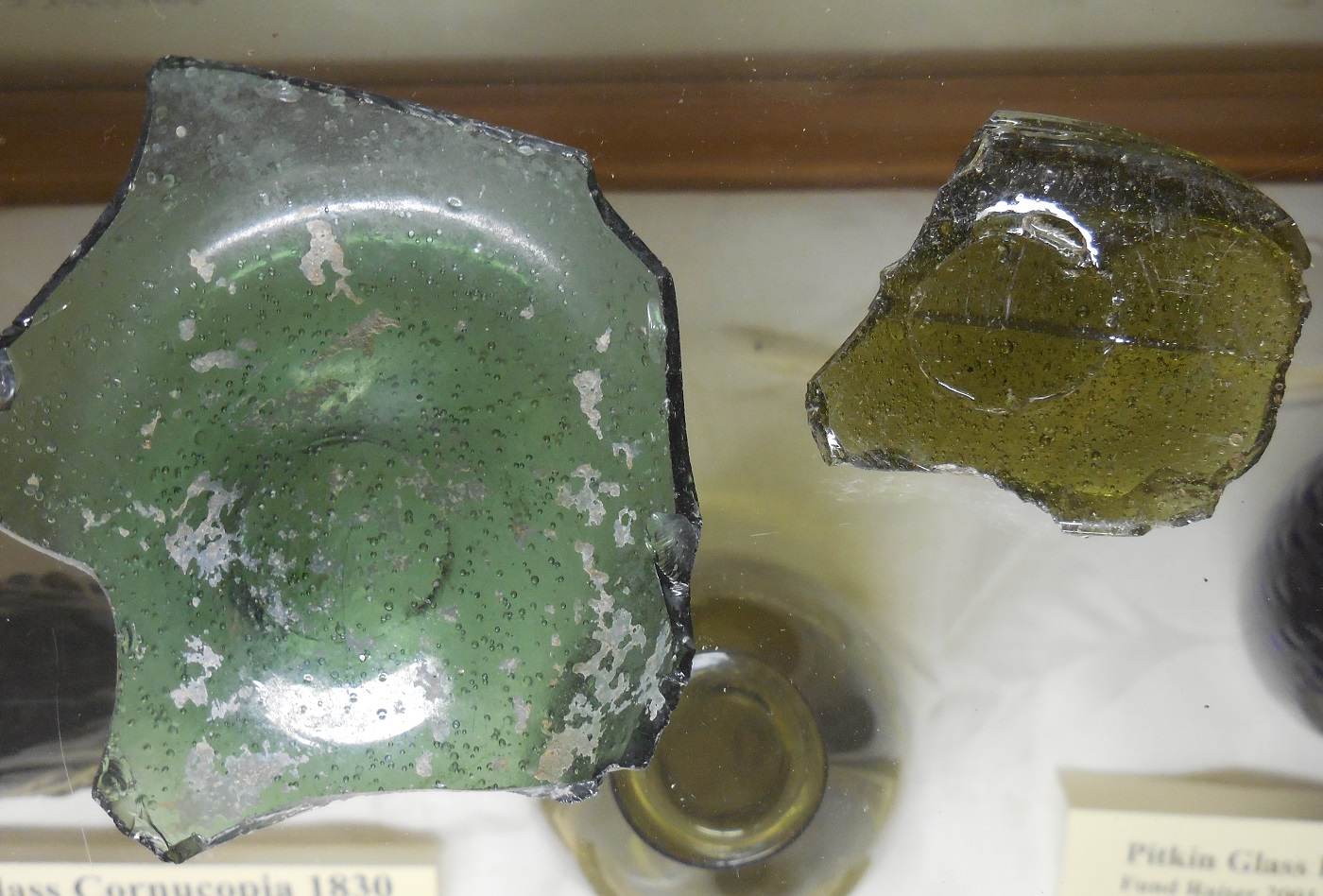
| Some shards from the Pitkin Glass Works site, with the pontiled base of a big free blown bottle in light blue-green, almost aquamarine, glass at left, and the base of an olive-green figured flask at right. The figured flask fragment included just a few non-distinctive portions of ribbed sides, and could be from any of a number of molds, such as one of the pint Pitkin sunbursts. |
 |
| Photographs of archaeological digs at the Pitkin site, with images of the miniature chestnut flask in situ. |
 |
| Early 20th century photograph of children playing on the Pitkin ruins, by John Knoll (1887-1955). |
 |
| 1965 oil painting of the Pitkin Glass Works by Nora Addy Drake, who also painted the (charmingly weird) murals at the nearby Shady Glen cheeseburger and milkshake joints. |
Admission to the Old Manchester Museum is by donation ($5 suggested). It's well worth a trip if you can catch the Museum during its open hours, particularly if you are interested in the rich lore surrounding what is perhaps America's most storied early glass factory.