Showing posts with label free blown. Show all posts

Saturday, December 30, 2017

Coventry Glass Works Pitchers

Free blown olive-amber pitcher, six inches tall. Attributed to Coventry Glass Works, via John Carpenter of Coventry.
 The Coventry Glass Works (1815-1848) are known, based on archaeological evidence and local lore, to have manufactured a range of free blown tableware, though tableware was probably a minor portion of their output compared to flasks and utility bottles. A fair number of "Coventry" pitchers exist in private and museum collections, though as always, the attribution of 200 year old free blown glass is subject to a certain degree of uncertainty, and similar items were made at various other nineteenth century glass factories in Connecticut and elsewhere in the Northeast.

Opposite side of the John Carpenter Coventry Glass Works pitcher
 The first Coventry pitcher that I have recently had a chance to examine supposedly came out of a house in Coventry, and is associated with an oldish note that reads: "This pitcher is guaranteed to be Coventry glass. It was bought around 1920 from John Carpenter of North Coventry and was blown by one of his ancestors. So he said." It is cracked to hell, but the provenance is better than average. This pitcher is in private hands, and will be auctioned by Norman C. Heckler & Co. in 2018.

Applied handle of John Carpenter pitcher.
Both likely-Coventry pitchers described here have a similar form, with threading wrapped around the mouth area. The handle was applied first near the top of the pitcher, then bent around and stuck to the side of pitcher, pulled out into a ribbon that was somewhat crudely flattened onto the pitcher body with a tool. The smooshed handle terminal is possibly an indication of Coventry origin.

Freeblown olive-green pitcher, 7.5 inches tall, attributed to Coventry Glass Works. Connecticut Historical Society collection.
The second Coventry Glass Works pitcher examined here is in the collection of the Connecticut Historical Society in Hartford. It's a larger example, in a lighter, greener color of glass, with more taper towards the base. It's a lovely piece of early Connecticut glass, but is not currently on display.
Applied handle of Coventry pitcher, Connecticut Historical Society.

Base of Coventry pitcher, Connecticut Historical Society.

Saturday, September 16, 2017

Early Glass at the MoCG

Free blown and dip mold glassware in the Marshall collection.
 The September open house at the Museum of Connecticut Glass featured a display by Tom Marshall, who specializes in unusual and early free blown, dip molded and pattern molded glass, of the type that could have been made by the eighteenth and early nineteenth century glass works of Eastern Connecticut. Many Museum regulars turned out to admire some spectacular antique bottles and tableware, and there was also a slow but steady stream of visitors from the general public.

Crude free blown inkwell, bottles and tableware.

Pattern molded corner, with Pitkin-type flasks, inkwell, and an extremely rare Pitkin hat (likely a salt cellar, or possibly a whimsey).

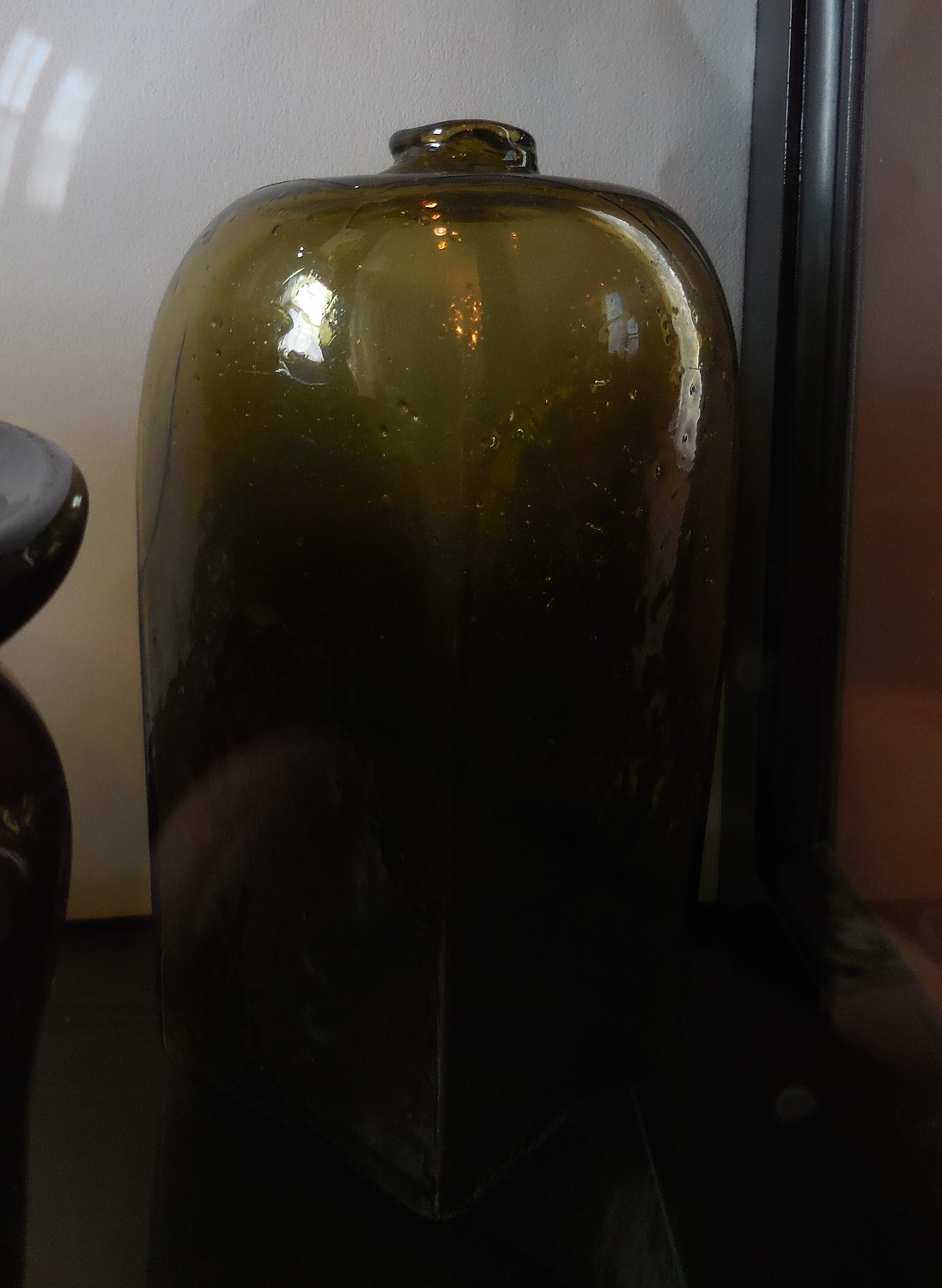
Early, flat-bottomed case-gin bottle whatzit with a plain sheared lip. Smaller than the common Continental case gins, in a more Connecticut-ish or New England-y glass color, with a very rare mouth treatment for this sort of bottle.

Large (baseball-sized) free blown inkwell.

"Coventry Glass Works" sign, likely not period.
Aside from the special glass from Tom Marshall, the Museum had a recent acquisition on display: a large blue painted wooden sign reading "Coventry Glass Works." This doesn't look all that old to me; it's pretty clean and the blocky sans-serif lettering looks kind of modern. Others who have examined the sign are also of the opinion that it's a twentieth century fantasy reproduction, not something that was ever hung outside the factory 200 years ago. Apparently a similar (also possibly not authentic) sign exists for the Willington Glass Co., in a private collection in the area.

Thursday, January 5, 2017

Heckler Winter 2017 Auction

GIII-5 pint Cornucopia / Urn flask.
Norman C. Heckler & Co. is running an absentee auction (Select Auction 145) this month, and as usual there are some interesting pieces of Connecticut glass on offer. At first glance, the flask above looks like the common (as 180+ year old American bottles go) GIII-4 from Coventry, but there is a circular depression in the middle of the urn, and collectors consider it to be a separate mold, GIII-5. The source of GIII-5 is uncertain, but given it's similarities to a known Coventry Glass Works bottle, it is quite possibly another Coventry product. This flask is listed as "scarce," meaning about 35-75 examples exist, and I would guess that the number of GIII-5s in the world is probably towards the lower end of that range.

GIII-5 obverse.
The cornucopia side of GIII-5 is also distinct from the common GIII-4, but in a less obvious way, with a somewhat irregular depression on the horn. Aside from these depressed areas, the 4 and the 5 appear to be identical.

GIII-5 base.
It's impossible to know for certain, but I suspect that GIII-5 actually was made in a GIII-4 mold, in the latter part of the mold's useful existence when it had accumulated damage, repairs or modifications that are responsible for the depressions on the urn and cornucopia. Similar, circular to irregular, depressions occur on occasional examples of the GI-81 pint Lafayette / liberty cap, and since half of the mold has survived to the present day, the defects in the mold that produced the variant flasks could be examined. The unlisted Connecticut sunburst flask in a previous Heckler sale could be an analogous situation, blown in a modified or deteriorating GVIII-3 mold. A pair of Pitkin Glass Works sunbursts are another candidate for this type of explanation, with GVIII-5a representing the original mold and GVIII-7 being the variant, almost identical except for a pair of faint circles added to one face.

Free flown New England chestnut bottle, light blue-green color.
The auction includes quite a few New England free blown bottles, both chestnut and globular forms. Some of the larger examples have cracks, cooling fissures or potstones with "radiations" (stress cracks); such imperfections seem to be very frequent with big chestnut bottles. The example above is a rarer color, either light blue-green or a very dark aquamarine. Glass in this color was produced at most early Connecticut glass works, but not in anything close to the quantities that murkier olive/amber/yellow/green glass was made.

GI-80 Coventry pint Lafayette / Dewitt Clinton flask, with rare Moxie bottle.
One of the pricier items in this sale will probably be a just about perfect, delicately colored Lafayette / Dewitt Clinton pint flask from the Coventry Glass Works (GI-80). This is another scarce flask, though based on the number that turn up, probably on the more numerous side of scarce. The small, early Moxie bottle with applied top is not too bad, either.

GII-66 quart eagle / New London Glass Works flask.
The New London Glass Works (1856-65) technically fall outside of Connecticut's quiet corner, but were another manufacturer of figured flasks in the eastern part of the state. The large, quart size GII-66 eagle flask is a rare bottle, though this specimen in aquamarine glass and with a smooth base is not quite as desirable as the pontiled examples in clear shades of green and amber that exist. New London was active later than most of the Connecticut glass factories that I write about, and generally produced a more refined type of bottle glass than that made by Coventry or Pitkin. Glass in nearly colorless aquamarine, or the bright, clean colors seen in some New London bottles is rare or absent from the products of the early 19th century Connecticut glass works. 

Monday, August 15, 2016

A Unique Bottle from Coventry


The Connecticut Historical Society has a collection of interesting bottles, glassware and related artifacts from the state's eighteenth and nineteenth century glass works, and one of the most important glass objects in their archive is a heavy, clear olive-green freeblown bottle thought to have been made at the Coventry Glass Works. This "pinch bottle" is roughly square in cross section, pinched to fuse opposite walls of the bottle together and create wavy internal tubes at each corner, between upper and lower chambers, and two more tubes in the wall at the center of the bottle. The center tubes are narrow, and one of them looks like it might not be open all the way through. This style of bottle is known from European glass houses, but as an American and Connecticut product, this specimen is probably unique.


The Coventry pinch bottle is illustrated in American Glass (George and Helen McKearin, 1948) and in American Bottles & Flasks and Their Ancestry (Helen McKearin and Kenneth Wilson, 1978). McKearin and Wilson report that bottle was recovered in the Coventry area around the time of World War I, and that it matches the description of a Coventry bottle said by Edwin Atlee Barber to have been owned by Nathaniel Root, son of the first agent of the Coventry Glass Works.


An old collector's label has the inscrutable legend: B3 ARR #7 R.11.BB. I wonder if anyone still knows what any of that means?


The lip is also peculiar for an early American bottle: sheared and tooled into an outward flare, without any applied glass. The contexts where one does see similar lip treatments is early decanters (which is, I would imagine, how this particular object was used), and nineteenth century cologne bottles.


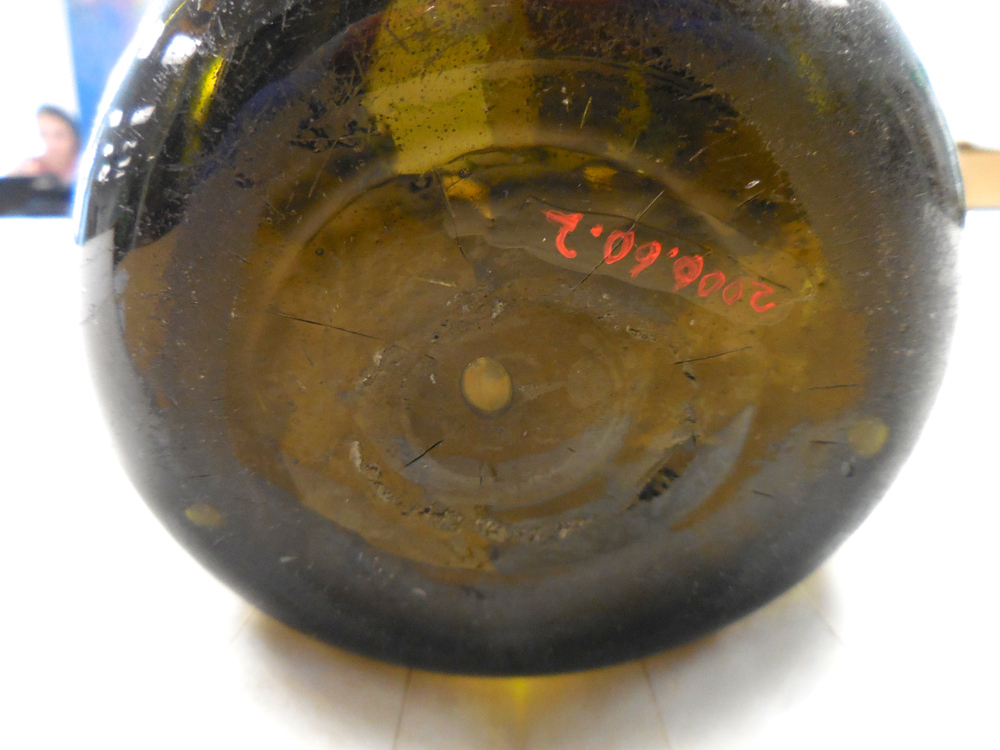
The flattened base of the probable decanter is also highly unusual, with a deeply impressed, cross-shaped pontil mark. The interior of the impression is surprisingly smooth, with only a couple of small patches of broken glass adhering from the pontil rod. Also visible in this view is a crack that traverses the bottom of the bottle and extends part way up one side.


The Coventry pinch bottle is a crudely beautiful example of the glassblower's art, and a remarkable survival from the golden age of American glass making.

Sunday, April 17, 2016

Museum of Connecticut Glass Season Opener

The John Turner House.
 The Museum of Connecticut Glass started its 2016 season of open houses this weekend, with tours of the ca. 1813 house of John Turner, one of the incorporators of the Coventry Glass Works. The temperatures were a bit cool, especially inside of the Turner house, with its massive double-layered brick walls and dearth of windows on the south side, but the weather was clear and bright and turnout was good.
The MCG barn, with guests arriving.
 The guests included some locals who saw the "open" signs and were curious, and also people who had traveled specifically to see the Museum. One fellow was an antique building specialist who was more interested in the Turner house itself than Connecticut glass; he was absolutely ecstatic to see that the structure had been stabilized, but was otherwise in mostly unrenovated condition, with 200 years of modifications and a lot of well-used grunginess. Visitors like seeing the house, but that sort of deep enthusiasm was something I hadn't encountered before.

Display of early bottles, of the kind made at the Pitkin Glass Works. L-R: black glass wine bottle, chestnut bottle, Pitkin-type flask, GVIII-7 pint sunburst flask, dip molded snuff bottle.
The display this month was glass connected with the Pitkin, Coventry and Willington glass factories, along with the more permanent collections of memorabilia and excavated shards from Coventry, and a small exhibit on the Meriden Flint Glass Company. The next open house will be May 21, 2016, in association with the Museum's annual tailgate-style bottle and glass sale. 

Saturday, March 5, 2016

Heckler & Co. Auction 133, Spring 2016

Large New England Pitkin-type flask, 36 rib broken swirl pattern, 7 inches tall.
 Heckler's is starting the 2016 season with one of their Premier auctions, which includes some spectacular Connecticut glassware. Especially notable in this auction is an abundance of very high-end Coventry Glass Works bottles, many of them from the Gary and Arlette Johnson collection.

Closeup of the label on the Pitkin flask.
Included in the sale are a number of Pitkin-type flasks, the most interesting of which is the unusually large, pint-sized specimen, of New England and likely Connecticut origin, pictured here. It has an early label, reading "Bourbon Whiskey / sold by Frank R. Hadley / Druggist & Chemist / New Bedford, Mass." with the monogram FRH on a fan. The label possibly isn't quite as old as the flask. Antique flasks that retain labels frequently seem to have been sold by druggists, and to have contained hard liquor or medicinal concoctions that were also mostly made of liquor. 

Free blown salt, likely Coventry Glass Works.
This pontiled, free blown New England salt was probably a Coventry Glass Works product. The color and form are consistent with known Coventry tableware, but the strongest evidence of origin in this case is that the salt was recovered by a picker from an old Coventry house.

"Dr H. W. Jackson / Druggist / Vegetable / Howe Syrup," a very rare, likely Coventry, pontiled medicine bottle.
Coventry "La Fayette / De Witt Clinton" flasks, GI-80 and GI-81
Coventry "La Fayette / De Witt Clinton" flask, GI-82
The trio of Lafayette - De Witt Clinton flasks is a desirable group of Coventry Glass Works bottles. The GI-82 half pint is a rare bottle in a nice, light, olive-yellow amber color, but this particular specimen has a wing of extra glass at the mold seam in the neck and such a mushy impression that most of the lettering is illegible verging on indiscernible. It's charming in its way, but must have bordered on being a factory defect to be tossed into the cullet basket.

Moon, star and hourglass masonic flask, GIV-29
This auction preview was probably about as close as I'm ever going to get to two masonic flasks, probably Coventry items but rare enough that the attribution is apparently equivocal, that are not quite at the top of the price scale of antique American bottles, but are still likely to sell for more than the cost of sensible new car. The hourglass GIV-29 is extremely rare, and probably unique in this medium, nearly pure green color, according to Norm C. Heckler. The other known examples have a more olive hue. The shape of this flask is interesting, with its oval outline but finely corrugated sides, which seem like they could be a design intermediate between the earliest Connecticut sunburst and Masonic flasks with angular shoulders and bold corrugations, and later flasks like the Coventry railroad and cornucopia flasks with simpler designs that lack the horizontal ribbing.

Square and compass with backwards "G" / star and keys masonic flask, GIV-30. Reverse and obverse of the same specimen.
The Coventry GIV-30 masonic flask is thought to be slightly less rare than the GIV-29, but is likely to bring a higher price at auction. An example in a similar light color, but severely cracked, sold for more than $4000 in a recent Heckler auction.

Thursday, November 12, 2015

Glass from the Liverant Collection

GII-2 three-mold geometric inkwell, Coventry Glass Works.
The late Phil Liverant of Colchester, Connecticut was a respected collector of New England antiques of all kinds. Among other things, he had an impressive stash of early glass, composed in large part of Connecticut or probably Connecticut pieces. Late in October, on a stormy but unseasonably warm night, the first of three estate sales from the Liverant collection was held, possibly including the best of the bottles. A virtual who's who of New England glass collectors was in attendance, so there weren't any great bargains to be had; one described the bidding situation as "challenging." However, it was a pleasure just to see and handle some of the rarer items.

Coventry and Pitkin Glass Works flasks. GII-70 and GII-71 eagles, GVIII-18 and GVIII-5 sunbursts, two GIII-4 cornucopia/urns.
 Some excellent figured flasks were on offer, most in superb condition and a few with much stronger impressions than are usual for their molds. The pint Coventry eagle, for example, is a common bottle, but most specimens are so "whittled" that the eagles look like they've been dipped in batter and deep-fried. The mold impression here, though, is really crisp and detailed. The best of the flasks was the GVIII-5 Pitkin sunburst, in a clear olive green color and also with a very clean mold impression. McKearin and Wilson list this flask as common, but it seems to actually be fairly rare. There was some chatter during the preview about a foreign substance, possibly epoxy, on the lip that showed up under ultraviolet light, but this looked like a superficial spill of something to me, not a repair. Apparently, other bidders came to the same conclusion, and the bottle sold for over $3000.

Free blown globular bottles, less than two inches to about four inches high.
The October Liverant sale included four miniature globular bottles. One tiny bottle, less than two inches tall, is an especially rare thing. It was sold as part of the lot of three pictured above, and the grouping went for over $3000, despite including one bottle with a severely damaged lip, which would have been of very little value to a collector on its own. The attribution of free blown glass is an inherently dubious business, but these small bottles in light yellow olive colors, from an older eastern Connecticut collection, probably have a better chance than most of tracing back to Pitkin, Mather, Glastenbury or Coventry.

Open pontil of miniature globular bottle, ~1.8 inches tall. 


Pattern molded Pitkin-type salt cellar, two inches in diameter, dark olive-green.
One more object was the subject of intense interest from the antique glass crowd at the auction: a small salt cellar with faint Pitkin-type pattern molded ribbing, swirled to the left. This sort of blown glass is extremely rare; one long-time collector said that he had tried but failed to purchase this salt cellar from Phil Liverant years ago. It finally sold for about $2500, which was less than some people had predicted.

Pontiled base of the Pitkin-type salt cellar.

Tuesday, September 15, 2015

Pitkin Display at the Old Manchester Museum

Pitkin-type flask, decanter and utility bottles possibly made at the Pitkin Glass Works.
 The Old Manchester Museum, located on Cedar Street in Manchester Connecticut, is home to quite a nice educational display dealing with the Pitkin Glass Works. It includes bottles that are attributed with varying degrees of certainty to Pitkin, as well as associated artifacts, photographs, modern commemorative items and paintings, all labelled with useful explanations and donor information.

The Museum building.
 The Old Manchester Museum is operated by the Manchester Historical Society, and is currently open only one afternoon per month, on the second Sunday, although school group tours occur at other times and it is possible to arrange for special access. Exhibits include areas focusing on town schools, local sports figures, Bon Ami soap (based for a time in Manchester), the once extensive silk industry, quarries and dinosaur fossils, and the Spencer Repeating Rifle, the world's first practical multi-shot rifle, which was invented in Manchester and proved instrumental in winning the Civil War for the Union. All of this was informative, but I was mainly there for the Pitkin display.

The Museum has the massive iron lock to the glass factory door.

A free blown demijohn, 2-3 gallon capacity, donated in 1991 by Hazel Cooper. According to Cooper, this bottle was blown at the Pitkin Glass Works and passed down by descendants of the Pitkin family.

A "J.P.F." mold-blown inkwell, known from archaeological evidence to be a Pitkin product.

A miniature free blown chestnut flask, 1.8 inches high, side and bottom views. This flask was excavated by middle school students working with Connecticut State Archaeologist Nick Bellantoni at the Pitkin ruins, on May 14, 2003. This is truly a unique item, both in terms of its tiny size and impeccable Pitkin attribution. It also seems to be extremely unusual to find intact glassware actually on the site of an old glass factory. A 2012 article in the Manchester Journal Inquirer recounts collectors at the time of the dig offering $5,000, and then $20,000, for this odd little bottle, which has fortunately remained on public display.

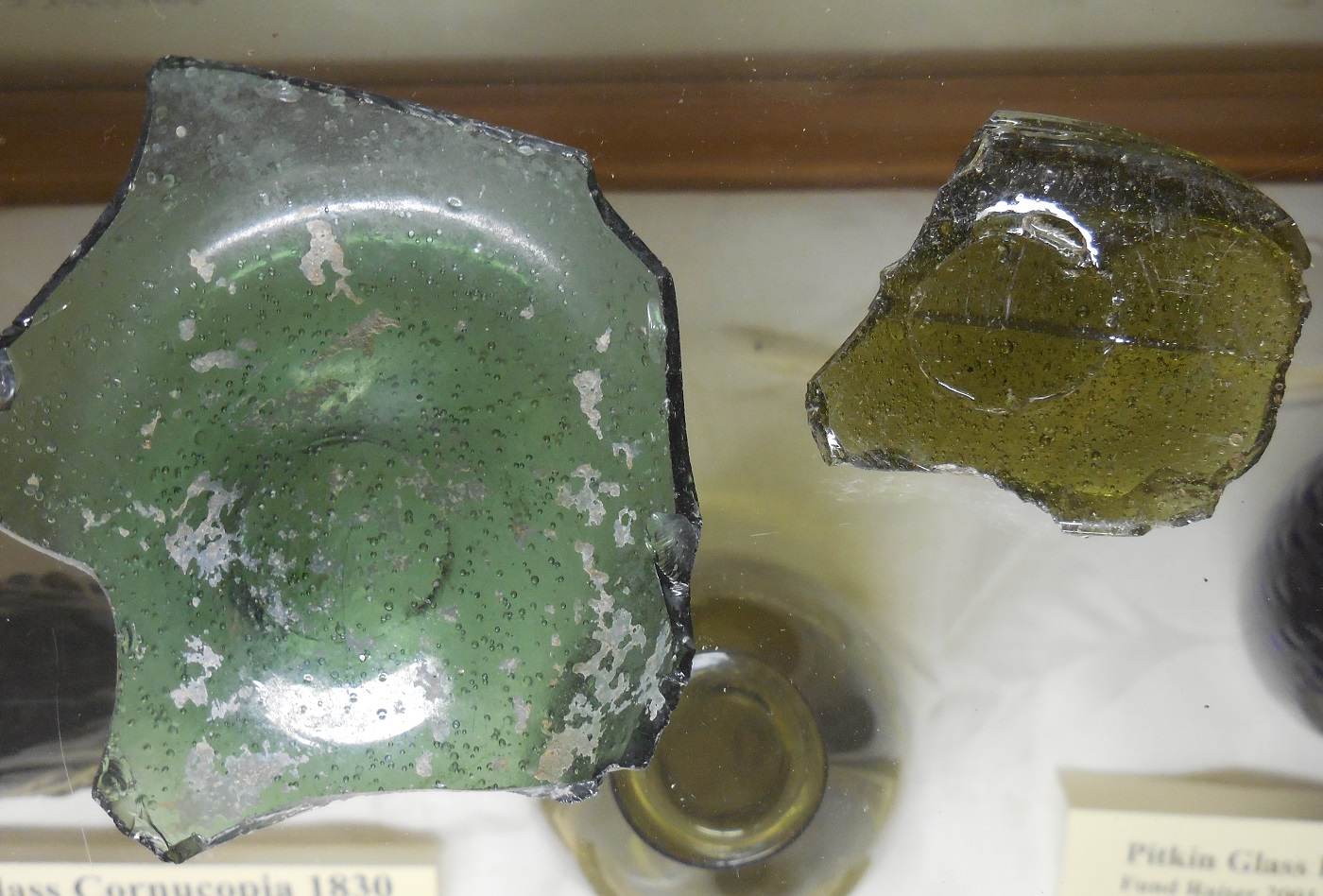
Some shards from the Pitkin Glass Works site, with the pontiled base of a big free blown bottle in light blue-green, almost aquamarine, glass at left, and the base of an olive-green figured flask at right. The figured flask fragment included just a few non-distinctive portions of ribbed sides, and could be from any of a number of molds, such as one of the pint Pitkin sunbursts.

Photographs of archaeological digs at the Pitkin site, with images of the miniature chestnut flask in situ.

Early 20th century photograph of children playing on the Pitkin ruins, by John Knoll (1887-1955).

1965 oil painting of the Pitkin Glass Works by Nora Addy Drake, who also painted the (charmingly weird) murals at the nearby Shady Glen cheeseburger and milkshake joints.
 Admission to the Old Manchester Museum is by donation ($5 suggested). It's well worth a trip if you can catch the Museum during its open hours, particularly if you are interested in the rich lore surrounding what is perhaps America's most storied early glass factory.