Showing posts with label Museum of Connecticut Glass. Show all posts

Sunday, June 25, 2017

Pitkin Flask Display

Pitkin-type flask display at the Museum of Connecticut Glass. June 17, 2017.
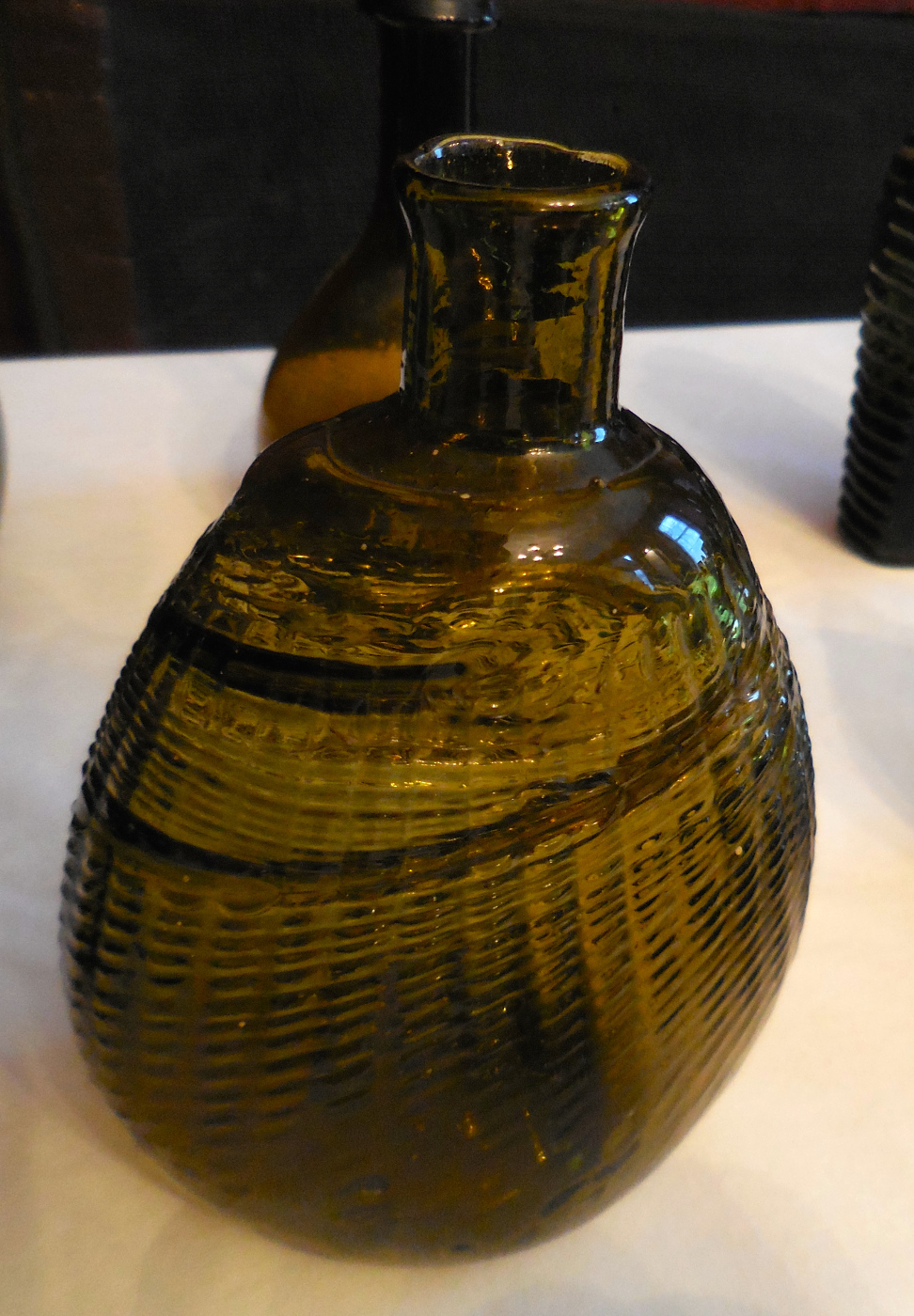
The June open house at the Museum of Connecticut Glass hosted a unique display of about 30 Pitkin-type flasks, plus some related bottles and inkwells. Dana Charlton-Zarro, a well-regarded specialist in this style of early American glass, was kind enough to bring up a portion of her fabulous collection for the open house, and to stay around to share her extensive knowledge of the bottles.

Dana's collection focuses on New England Pitkin-type flasks, many of which were indeed made at the Pitkin Glass Works, though more or less identical bottles were produced by the Coventry, Mather, Glastenbury and probably Willington glass factories in Connecticut, as well as in New Hampshire factories. Glassware in the same general style was produced in Mid Atlantic and Midwestern glass works, though the forms, colors and rib counts of New England Pitkins seem to be fairly distinctive.

The process of blowing Pitkin-type flasks was complex and required multiple steps executed by a skilled craftsman. Various modern glass studios, including Pairpoint on Cape Cod, have attempted to recreate New England Pitkins, though the delicate patterns and eggshell-thin glass of better antique flasks seems to be very difficult to replicate. At some point, probably around 1820, Pitkin-type flasks went out of production, replaced by sunburst flasks and other styles of embossed bottles blown in two part metal molds, in a much less technically demanding procedure.

Dana Charlton-Zarro (with flask) explains the finer points of Pitkin-type flasks to some Museum visitors.

The gaffer had some difficulties with this bottle: some sections of the sides got folded over and stuck to themselves during the blowing process.

Some smaller Pitkin flasks, between four and five inches tall. Pitkins below five inches tall (or more than seven inches) are relatively rare.

Pitkin type inkwells. The squared-off example (center left) was probably expanded in a dip mold for snuffs, and was recovered from a Connecticut stream bank relatively recently. The "cross-swirled" example (center right), with ribs curved to the left and to the right, is also very rare.

Some more special Pitkins: pint and half-pint examples in a blue-green color, with barely any hint of olive (the color is more blue in person), and a greenish, wide, flattened bottle with very tight ribbing.


Sunday, May 21, 2017

Museum of Connecticut Glass 2017

Center of the National Historic Glass Factory District in Coventry, Ct: the old University of Connecticut agricultural experiment barn, the Capt. John Turner house (both MoCG property) and the Nathaniel Root house.

 The Museum of Connecticut Glass started their 2017 schedule of public events with the annual antique glass and bottle show. Tours were also offered of the John Turner house, which was built ca. 1812-1813 by one of the incorporators of the Coventry Glass Works.

The sales field at the Coventry glass show, May 20, 2017.
  In spite of some cool, cloudy weather with a few drops of rain for the first half of the show, there was a great selection of glass up for sale, and a decent turnout of buyers, though it possibly wasn't as busy as some other Coventry shows in recent years. There was a conflict with another area glass sale, which probably didn't help, at least from the seller's point of view.

Stoneware, case bottles and more on offer.

Some of the good stuff: Willington, Westford and New London flasks.

A Coventry DEWITT CLINTON / LAFAYETTE half pint historical flask, GI-81.

There weren't many New England Pitkin flasks available at the show this year, but in June there will be a chance to check out one of the best collections of Pitkin flasks anywhere...

Connecticut or New England Pitkin-type flasks. 

Next month's Museum activity will be a display of Pitkin-type flasks and related early American glass, with expert Dana Charlton-Zarro on hand to share her knowledge of the subject. This will, I believe, be the first time that Dana has traveled to the Pitkin homeland in Connecticut to give a public talk about her favorite antique bottles, and it should be a special opportunity to see and learn about a beautiful and widely admired class of early glassware. The Pitkin display will be held Saturday, June 17, 1:00-4:00 at the Museum of Connecticut Glass.

Future MoCG open houses will be held the third Saturday of each month, 1:00-4:00, through the autumn. Special exhibits will include:
July 15 - Victorian glass tableware manufacture in Connecticut, with Nick Wrobleski (tentative).
• August 19 - Coventry Glass Works flasks and other antique Connecticut blown-in-mold glass.
• September 16 - early Connecticut freeblown and pattern-molded tableware, whimsies and other rarities, with Tom Marshall.
• October 21 - TBA.

Sunday, April 17, 2016

Museum of Connecticut Glass Season Opener

The John Turner House.
 The Museum of Connecticut Glass started its 2016 season of open houses this weekend, with tours of the ca. 1813 house of John Turner, one of the incorporators of the Coventry Glass Works. The temperatures were a bit cool, especially inside of the Turner house, with its massive double-layered brick walls and dearth of windows on the south side, but the weather was clear and bright and turnout was good.
The MCG barn, with guests arriving.
 The guests included some locals who saw the "open" signs and were curious, and also people who had traveled specifically to see the Museum. One fellow was an antique building specialist who was more interested in the Turner house itself than Connecticut glass; he was absolutely ecstatic to see that the structure had been stabilized, but was otherwise in mostly unrenovated condition, with 200 years of modifications and a lot of well-used grunginess. Visitors like seeing the house, but that sort of deep enthusiasm was something I hadn't encountered before.

Display of early bottles, of the kind made at the Pitkin Glass Works. L-R: black glass wine bottle, chestnut bottle, Pitkin-type flask, GVIII-7 pint sunburst flask, dip molded snuff bottle.
The display this month was glass connected with the Pitkin, Coventry and Willington glass factories, along with the more permanent collections of memorabilia and excavated shards from Coventry, and a small exhibit on the Meriden Flint Glass Company. The next open house will be May 21, 2016, in association with the Museum's annual tailgate-style bottle and glass sale. 

Sunday, August 16, 2015

Museum of Connecticut Glass August Open House

Set of the three sizes of Willington pickle bottles.
 This weekend there was another open house at the Museum of Connecticut Glass in Coventry. The weather was hot, sunny and humid, and this time of year half of the local population is probably on vacation at some mountain lake or Cape Cod beach house, so attendance was apparently down from previous events. Still, there was a pretty steady flow of visitors through the Museum.

Me in the Captain John Turner house, with some of the displays.
 The displays this time included figured flasks and other glass from eastern Connecticut glass works, with quite a few Coventry flasks that were of special interest to some of the neighbors of the Museum who stopped in at one point. The exhibit area in the Turner house stayed pleasantly cool for most of the day; the brick walls were constructed in an old English style and are very thick, so the building takes some time to heat up even on a sunny mid-August day.

Amber utility bottles: the whiskey cylinder (middle left) is embossed "Willington Glass Works," the demijohns and beer bottle are in the style of Willington glass, but could be from Westford or elsewhere in New England.
The Willington Glass Company had an extraordinarily long run, from 1815 to 1872, so it is somewhat surprising that the types of glassware that can be attributed to Willington with any degree of confidence are quite limited, and mostly date to the final 20-30 years of the company's operations. There are the well-known square cathedral pickle bottles, a couple of base-embossed cylindrical whiskey bottles, some late figured flasks with simplistic eagle designs, an electrical insulator, one variant of a sarsaparilla bottle, as well as paneled blueberry bottles and a few other styles of utilities that are generally associated with Willington. That's about it, aside from a few individual items linked to Willington by family tradition, for whatever that's worth. It seems as if for much of the history of the factory, production was dominated by generic unmarked demijohns, snuff bottles, beers, flasks etc., of types that could also have easily been made at any of a number of other New England glass works. It would be interesting if future archaeological investigations at the site could find evidence of other distinctive Willington products; one wonders if some of the early, pre-1840 figured flasks of unknown origin might have been made there.