Showing posts with label Willington Glass Company. Show all posts

Sunday, October 29, 2017

Fall 2017 Glass Miscellany


Pitkin Glass Works ruins, October 2017.
It hasn't been the best fall foliage season here in Connecticut. A Gypsy Moth outbreak and a severe thunderstorm with hail caused trouble for the trees in a lot of places back in June, and autumn 2017 has so far alternated between too dry and warm, and a couple of periods of wind and rain that have tended to knock a lot of leaves to the ground. Still, there are scenic views here and there, including the Pitkin Glass Works ruins in Manchester.

New sign for the ruins site.
The Pitkin site has a new sign, featuring a Pitkin-type flask. The old sign had a painting of a free blown demijohn sort of bottle.

The old Center Turnpike crosses a wooden bridge in Boston Hollow, heading west into Westford.
The location of the Westford Glass Company is the most isolated of the early glass works sites in Connecticut. A moderately busy state road, Rt. 89, passes by the factory site, but Westford is a quaint and thinly populated village, and it's right on the edge of Boston Hollow and the Yale-Myers forest, an expansive undeveloped tract that is probably about as close as the Nutmeg State gets to a wilderness area.
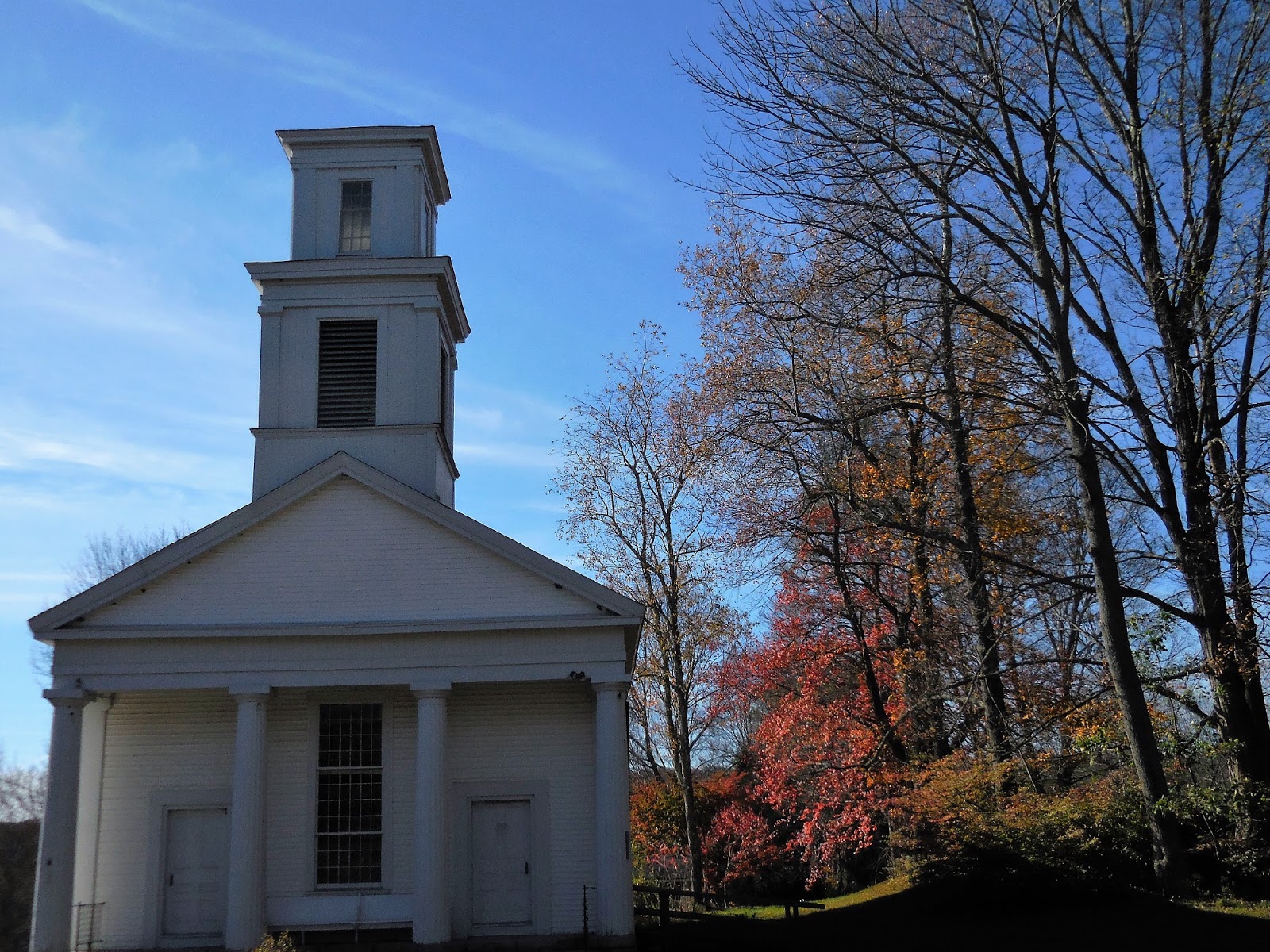
The disused but preserved church in the center of Westford, a few hundred yards from the foundations of the Westford Glass Co.
The October 2017 Heckler & Co. live auction.
We're entering a busy couple of weeks for specialist bottle auctions, with several online sales going on now or starting soon. Here in Connecticut, Norman C. Heckler & Co. just had one of their live auctions, where there was some good local antique glass up for bidding, including an amber Willington blueberry preserve bottle and a large, light yellow olive chestnut bottle (both at upper left in the auction floor photo). The blueberry bottle went for something approaching a retail price, but the chestnut was a bargain.

PATENT insulator, Willington Glass Co.
In November, Heckler's is having an online sale. One interesting Connecticut piece is an insulator embossed PATENT (with the letters reversed). There are two or three variants of this item, all thought to be made in Willington, with reports of shards being found at the glass factory site and also along railroad tracks in the area. Apparently, insulator collectors don't necessarily think that these were insulators, and there is some speculation that they were some kind of decorative architectural accent (whether or not a big pyramidal chunk of dark muddy olive glass with "PATENT" written backwards all over it in block letters is "decorative," is, I suppose, a matter of taste).

GI-33 WASHINGTON / JACKSON pint historical flask, Coventry Glass Works (left) with three GI-32 New England Washington flasks.
The sale preview also offered a chance to examine a somewhat confusing group of flasks, the GI-31, 32 and 33 Washington/Jackson pints. These are quite similar to each other, and I've seen well-known specialists mix them up. Of interest to the staff here at Quiet Corner Glass is the GI-33, which was the Coventry Glass Works version of this type of Washington flask. The easiest field mark of the 33 is that the lettering is noticeably smaller than with the other two molds, with the W in "Washington" being placed opposite G.W.'s receding hairline. In the 31 and 32 flasks, the W is down at eye level. GI-31 is probably a Keene-Marlboro St. (NH) flask, whereas GI-32 is of uncertain New England origin.

Saturday, May 6, 2017

Heckler Auctions Spring 2017

The Heckler property, April 2017.
The Heckler & Co. live auction season started up last week, with a nice selection of old bottles, other glass and a bit of stoneware. There were some of the more common Willington, Westford and Coventry flasks up for bidding. I picked up a matched pair of early dip-molded New England snuff bottles.
The live auction setup inside the barn, Norm C. Heckler in the vest.
Heckler's absentee auction 148.
Heckler's also had their May online auction up for previewing. As usual, there are going to be some quality Connecticut bottles included in the sale.

Coventry Glass Works pint sunburst flask, GVIII-3.
The GVIII-3 Coventry sunburst in this sale has excellent glass quality and a fine color on the greener side of olive, but some minor cooling cracks in the shoulders. Another notable Connecticut sunburst flask in the sale will be a GVIII-5a, probably from the Pitkin Glass Works; quite a rare flask but not quite a perfect example.

BY A.A. COOLEY HARTFORD CON blacking bottles, with insect powder and smelling salts bottles.
Two examples of what is thought to be a boot-blacking bottle made in Coventry, embossed A.A. Cooley, will be on offer. These come up for sale on a pretty regular basis, but the ones here have strong embossing and are probably better than most. 

GII-64 pint eagle flask, Willington Glass Company.
This Willington eagle flask is another relatively common bottle, but in a warm amber that stands out from the usual run of murkier, olive-amber Willington glass.

GII-68, pint eagle/anchor flask, New London Glass Works.
This New London flask is a warmer, lighter, cleaner shade of amber still. This color and quality of glass probably would have been nearly impossible for an earlier factory like Willington to achieve.

Monday, February 13, 2017

Willington Pickle Bottle Variant

Willington pickle bottle, typical small-size example.
The Willington Glass Company in West Willington, Connecticut is the source of three different sizes of cathedral pickle bottles, of a distinctive square, wide, chunky-looking and ornately decorated design. The smallest Willington pickle is about eight inches tall and three inches wide, with three sides with fancy cathedral-window designs with hanging "bellflower" decorations, and one plain label side. In typical examples, the three bellflowers are all more or less identical.

Variant small pickle bottle, side A.
Some years ago, two cathedral pickle bottles that were similar to the small Willington pickle turned up in a barn in Wallingford, Connecticut (about 40 miles from Willington). The details of the embossing on these two bottles is slightly different from typical examples, however, and it seems as if two different molds were used to produce small Willi pickles.

Variant small pickle bottle, side B.
 In the variant small Willington pickle, the three bellflowers are all slightly different from each other, and different from the bellflowers on the typical bottles. In the photos, variant side A is pretty similar to a typical example, but side B has noticeably more widely spreading petals on the dangling flower. On side C, the cathedral decoration doesn't have a component that really looks like a flower at all, instead bearing two loops and and a detached dot on its lower side. The fact that the variant bottle is shorter than the typical bottle pictured here, with a stubby neck, isn't significant, as the necks of these bottles are inherently variable, having been largely formed by hand.

Variant small pickle bottle, side C, with loops and dot design.
Whether the variant pickle bottle was actually made in Willington is an open question. It's almost identical to the small Willi pickle in most ways, but the differences in the bellflowers indicate that two different molds were used, although it might be possible that the differences are due to modifications made to a single mold. The owner of one of the variant bottles speculates that it could be a product of a different glass works, possibly New London.

Open pontil on base of variant pickle bottle.
In a further complication, Norman C. Heckler once owned a cathedral pickle bottle that he says was close to the Willington pickle bottles in form, but was distinctly smaller than the smallest of the three known sizes of bottle from Willington. Possibly, West Willington might have been the source of five different cathedral pickles.

Tuesday, June 28, 2016

Heckler Auction 138

Connecticut eagle flasks: GII-62 and GII-71
Norman C. Heckler & Co.'s July online auction, number 138, was set up for an early preview this past weekend, during their June live auction. I don't know if it was planned that way or not, but the offerings include specimens of many of the Bald Eagle themed flasks from northeastern Connecticut, just in time for Independence Day. The Coventry Glass Works eagle/eagle half-pint is a nice example, with lighter, greener glass and a cleaner impression than most.

Willington Glass Co. quart eagle flask, GII-61.
Willington Glass Co. eagle half-pint (GII-63) and pint (GII-62), with free blown handled jug.
Ther auction will have just about a complete set of the Willington Glass Co. eagle flasks (I'm not sure if both of the GII-63 variants were represented), which would also be a complete set of all the figured flasks that are thought to have been manufactured in Willington. The large quart Willi. eagle has a cooling crack in the neck (of the bottle, not the eagle); those sorts of manufacturing defects seem to be pretty common with this mold. 

"BY A A COOLEY HARTFORD CON"
The A.A. Cooley boot-blacking bottle is thought to be a Coventry Glass Works product. These turn up for sale on a fairly regular basis, but the embossing of the letters on this bottle is especially strong.

Pint sunburst flask, probably Pitkin Glass Works GVIII-5a.
There will be a very nice Connecticut sunburst flask in the sale, which I believe is GVIII-5a. This is a quite a rare bottle, but unfortunately this example has a chunk knocked out of the shoulder, somewhat crudely filled in with epoxy.

--
Edit to add: Heckler's listed the sunburst flask as a GVIII-7 variant, and it does have two faint dots near the shoulders on the face opposite the one in the photo. It's definitely not a proper GVIII-7, though, with the circle in the center of the sunburst only present on one side, and with fairly angular shoulders that give the whole bottle an outline that's pretty close to the Coventry GVIII-3. Norm Heckler Sr. says that he didn't quite know what to make of this bottle, which probably doesn't happen very often.  

Monday, October 26, 2015

Heckler's Autumn Auctions

Norman C. Heckler & Co., October 2015.
The Norman C. Heckler & Co. auction house recently held one of their very occasional invitation-only live auctions. It was a beautiful autumn day for it, a bit on the cool side but with plenty of sun. It was peak fall foliage season for the sugar maples around the historic farm where Heckler's is located.

Norman Heckler Sr. lays down the law on auction rules.
The turnout at the auction was pretty high, with maybe 60-70 bidders. I'm not sure what the criteria for getting an invitation were, but I suspect it was more or less "had registered for a live auction within the past couple of years." The format was similar to other live auctions I've attended, with about 130 lots, ranging from giant table lots of flea market fodder to single bottles. Most lots probably went for a couple of hundred dollars, with one large group of 19th century soda bottles fetching about $1700. 

GII-62 Willington Glass Co. eagle, pint flask.
The selection of old Connecticut glass was a bit limited compared to typical Heckler sales. There were several different Willington eagle flasks, including the nice GII-62 above, which was tempting. The Pitkin-type flask below was an odd one, described as Midwestern by the auctioneers because of the color and relatively rounded, broad shoulders. The overall tall, skinny oval form is a little suggestive of New England Pitkins, however, with Midwestern examples tending to be closer to round. It's also worth noting that there is good evidence from glass works excavations and the distribution of 20th century bottle finds that what collectors call "Midwestern Pitkins" actually were made at very early Mid-Atlantic factories. In any case, this was a lovely old bottle that went for not much money, because of a faint crack in the lip.

Pitkin-type flask, 32 ribs, swirled to the right, pint size, 6 3/4 inches tall.
Heckler's absentee auction preview shed.
Heckler's also had their November absentee auction up for preview. This will be one of their "select" auctions, with bottles that are nice, but generally not quite as fancy as would wind up in a "premier" auction. There were some good items from Connecticut glass houses, as well as some Connecticut/New England items that are difficult to pin down to a specific origin, like a pair of small Pitkin-type flasks, one with very well-defined ribbing and one with very soft, fuzzy pattern-molding. There is an especially large selection of Coventry Glass Works flasks with bolder impressions than are usually seen from their respective molds.

GII-70 Coventry Glass Works eagle pint, in the upcoming autumn absentee auction, as are all the other bottles pictured in the rest of this post.
GI-85 "LaFayette/Covetry/C-T"; liberty cap pint flask.
GV-6 "Success to the Rail Road" Coventry pint flask.
GV-10 "Railroad Lowell" Coventry half-pint flask.
Reversed "Patent" electrical insulator, probably Willington Glass Co.

Sunday, August 16, 2015

Museum of Connecticut Glass August Open House

Set of the three sizes of Willington pickle bottles.
 This weekend there was another open house at the Museum of Connecticut Glass in Coventry. The weather was hot, sunny and humid, and this time of year half of the local population is probably on vacation at some mountain lake or Cape Cod beach house, so attendance was apparently down from previous events. Still, there was a pretty steady flow of visitors through the Museum.

Me in the Captain John Turner house, with some of the displays.
 The displays this time included figured flasks and other glass from eastern Connecticut glass works, with quite a few Coventry flasks that were of special interest to some of the neighbors of the Museum who stopped in at one point. The exhibit area in the Turner house stayed pleasantly cool for most of the day; the brick walls were constructed in an old English style and are very thick, so the building takes some time to heat up even on a sunny mid-August day.

Amber utility bottles: the whiskey cylinder (middle left) is embossed "Willington Glass Works," the demijohns and beer bottle are in the style of Willington glass, but could be from Westford or elsewhere in New England.
The Willington Glass Company had an extraordinarily long run, from 1815 to 1872, so it is somewhat surprising that the types of glassware that can be attributed to Willington with any degree of confidence are quite limited, and mostly date to the final 20-30 years of the company's operations. There are the well-known square cathedral pickle bottles, a couple of base-embossed cylindrical whiskey bottles, some late figured flasks with simplistic eagle designs, an electrical insulator, one variant of a sarsaparilla bottle, as well as paneled blueberry bottles and a few other styles of utilities that are generally associated with Willington. That's about it, aside from a few individual items linked to Willington by family tradition, for whatever that's worth. It seems as if for much of the history of the factory, production was dominated by generic unmarked demijohns, snuff bottles, beers, flasks etc., of types that could also have easily been made at any of a number of other New England glass works. It would be interesting if future archaeological investigations at the site could find evidence of other distinctive Willington products; one wonders if some of the early, pre-1840 figured flasks of unknown origin might have been made there.