Wednesday, February 3, 2016

John Mather House

John Mather's house, January 2016
John Mather, of the Parker Village area of Manchester (formerly East Hartford), Connecticut, was an early nineteenth century merchant and manufacturer of gunpowder and glass. The Mather Glass Works have been an object of speculation among students of early American glass for some time; they were long known only from period advertisements and brief newspaper articles. John Mather's 1827 house still stands on Mather Street, close to the site of his glass factory, though the factory seems to have ceased operations about six years before the house was built.

The area around Mather's house and its small corner plot of land was subject to intense suburban residential and industrial development in the mid-twentieth century, and any above-ground remains of the glass works that might have existed at the time were apparently bulldozed. My own preliminary investigations of the site have turned up period glass, bricks, furnace lining and other typical glass factory waste beneath some of the back yards in the neighborhood. The shards that have turned up indicate that Mather's factory made typical New England free blown, dip molded and pattern molded glassware, but so far there has been no indication of the production of historical flasks or other glass blown in more advanced two part metal molds. 

John Mather's house in a painting by Russell Cheney (1881-1945) that hangs in the Manchester Masonic Temple. Note that the giant white oak on the corner has hardly changed in the past 70 years or more. Photo via the Manchester Historical Society.

Pitkin Glass Works ruins, January 2016
The famous Pitkin Glass Works ruins are located less than two miles south of Mather's house, but have been preserved and stabilized, and are generally much more thoroughly studied and understood than the Mather Glass Works. This spring, when the weather warms up, I hope to get back to some of the properties on Mather Street where I have received permission to excavate shards, and eventually gather enough material to write up a more formal description of the likely products of the glass works there.

Thursday, November 12, 2015

Glass from the Liverant Collection

GII-2 three-mold geometric inkwell, Coventry Glass Works.
The late Phil Liverant of Colchester, Connecticut was a respected collector of New England antiques of all kinds. Among other things, he had an impressive stash of early glass, composed in large part of Connecticut or probably Connecticut pieces. Late in October, on a stormy but unseasonably warm night, the first of three estate sales from the Liverant collection was held, possibly including the best of the bottles. A virtual who's who of New England glass collectors was in attendance, so there weren't any great bargains to be had; one described the bidding situation as "challenging." However, it was a pleasure just to see and handle some of the rarer items.

Coventry and Pitkin Glass Works flasks. GII-70 and GII-71 eagles, GVIII-18 and GVIII-5 sunbursts, two GIII-4 cornucopia/urns.
 Some excellent figured flasks were on offer, most in superb condition and a few with much stronger impressions than are usual for their molds. The pint Coventry eagle, for example, is a common bottle, but most specimens are so "whittled" that the eagles look like they've been dipped in batter and deep-fried. The mold impression here, though, is really crisp and detailed. The best of the flasks was the GVIII-5 Pitkin sunburst, in a clear olive green color and also with a very clean mold impression. McKearin and Wilson list this flask as common, but it seems to actually be fairly rare. There was some chatter during the preview about a foreign substance, possibly epoxy, on the lip that showed up under ultraviolet light, but this looked like a superficial spill of something to me, not a repair. Apparently, other bidders came to the same conclusion, and the bottle sold for over $3000.

Free blown globular bottles, less than two inches to about four inches high.
The October Liverant sale included four miniature globular bottles. One tiny bottle, less than two inches tall, is an especially rare thing. It was sold as part of the lot of three pictured above, and the grouping went for over $3000, despite including one bottle with a severely damaged lip, which would have been of very little value to a collector on its own. The attribution of free blown glass is an inherently dubious business, but these small bottles in light yellow olive colors, from an older eastern Connecticut collection, probably have a better chance than most of tracing back to Pitkin, Mather, Glastenbury or Coventry.

Open pontil of miniature globular bottle, ~1.8 inches tall. 


Pattern molded Pitkin-type salt cellar, two inches in diameter, dark olive-green.
One more object was the subject of intense interest from the antique glass crowd at the auction: a small salt cellar with faint Pitkin-type pattern molded ribbing, swirled to the left. This sort of blown glass is extremely rare; one long-time collector said that he had tried but failed to purchase this salt cellar from Phil Liverant years ago. It finally sold for about $2500, which was less than some people had predicted.

Pontiled base of the Pitkin-type salt cellar.

Monday, October 26, 2015

Heckler's Autumn Auctions

Norman C. Heckler & Co., October 2015.
The Norman C. Heckler & Co. auction house recently held one of their very occasional invitation-only live auctions. It was a beautiful autumn day for it, a bit on the cool side but with plenty of sun. It was peak fall foliage season for the sugar maples around the historic farm where Heckler's is located.

Norman Heckler Sr. lays down the law on auction rules.
The turnout at the auction was pretty high, with maybe 60-70 bidders. I'm not sure what the criteria for getting an invitation were, but I suspect it was more or less "had registered for a live auction within the past couple of years." The format was similar to other live auctions I've attended, with about 130 lots, ranging from giant table lots of flea market fodder to single bottles. Most lots probably went for a couple of hundred dollars, with one large group of 19th century soda bottles fetching about $1700. 

GII-62 Willington Glass Co. eagle, pint flask.
The selection of old Connecticut glass was a bit limited compared to typical Heckler sales. There were several different Willington eagle flasks, including the nice GII-62 above, which was tempting. The Pitkin-type flask below was an odd one, described as Midwestern by the auctioneers because of the color and relatively rounded, broad shoulders. The overall tall, skinny oval form is a little suggestive of New England Pitkins, however, with Midwestern examples tending to be closer to round. It's also worth noting that there is good evidence from glass works excavations and the distribution of 20th century bottle finds that what collectors call "Midwestern Pitkins" actually were made at very early Mid-Atlantic factories. In any case, this was a lovely old bottle that went for not much money, because of a faint crack in the lip.

Pitkin-type flask, 32 ribs, swirled to the right, pint size, 6 3/4 inches tall.
Heckler's absentee auction preview shed.
Heckler's also had their November absentee auction up for preview. This will be one of their "select" auctions, with bottles that are nice, but generally not quite as fancy as would wind up in a "premier" auction. There were some good items from Connecticut glass houses, as well as some Connecticut/New England items that are difficult to pin down to a specific origin, like a pair of small Pitkin-type flasks, one with very well-defined ribbing and one with very soft, fuzzy pattern-molding. There is an especially large selection of Coventry Glass Works flasks with bolder impressions than are usually seen from their respective molds.

GII-70 Coventry Glass Works eagle pint, in the upcoming autumn absentee auction, as are all the other bottles pictured in the rest of this post.
GI-85 "LaFayette/Covetry/C-T"; liberty cap pint flask.
GV-6 "Success to the Rail Road" Coventry pint flask.
GV-10 "Railroad Lowell" Coventry half-pint flask.
Reversed "Patent" electrical insulator, probably Willington Glass Co.

Tuesday, September 15, 2015

Pitkin Display at the Old Manchester Museum

Pitkin-type flask, decanter and utility bottles possibly made at the Pitkin Glass Works.
 The Old Manchester Museum, located on Cedar Street in Manchester Connecticut, is home to quite a nice educational display dealing with the Pitkin Glass Works. It includes bottles that are attributed with varying degrees of certainty to Pitkin, as well as associated artifacts, photographs, modern commemorative items and paintings, all labelled with useful explanations and donor information.

The Museum building.
 The Old Manchester Museum is operated by the Manchester Historical Society, and is currently open only one afternoon per month, on the second Sunday, although school group tours occur at other times and it is possible to arrange for special access. Exhibits include areas focusing on town schools, local sports figures, Bon Ami soap (based for a time in Manchester), the once extensive silk industry, quarries and dinosaur fossils, and the Spencer Repeating Rifle, the world's first practical multi-shot rifle, which was invented in Manchester and proved instrumental in winning the Civil War for the Union. All of this was informative, but I was mainly there for the Pitkin display.

The Museum has the massive iron lock to the glass factory door.

A free blown demijohn, 2-3 gallon capacity, donated in 1991 by Hazel Cooper. According to Cooper, this bottle was blown at the Pitkin Glass Works and passed down by descendants of the Pitkin family.

A "J.P.F." mold-blown inkwell, known from archaeological evidence to be a Pitkin product.

A miniature free blown chestnut flask, 1.8 inches high, side and bottom views. This flask was excavated by middle school students working with Connecticut State Archaeologist Nick Bellantoni at the Pitkin ruins, on May 14, 2003. This is truly a unique item, both in terms of its tiny size and impeccable Pitkin attribution. It also seems to be extremely unusual to find intact glassware actually on the site of an old glass factory. A 2012 article in the Manchester Journal Inquirer recounts collectors at the time of the dig offering $5,000, and then $20,000, for this odd little bottle, which has fortunately remained on public display.

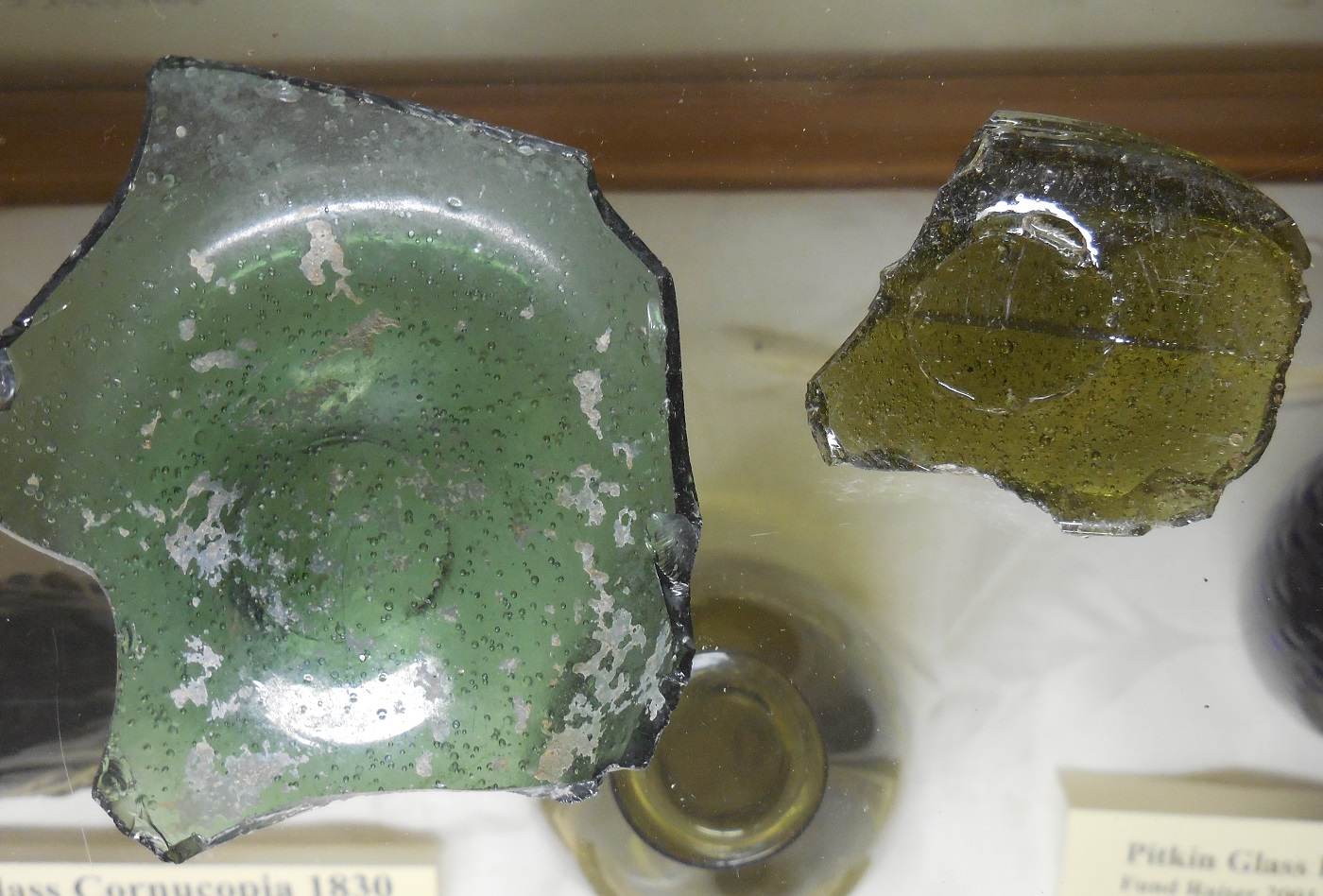
Some shards from the Pitkin Glass Works site, with the pontiled base of a big free blown bottle in light blue-green, almost aquamarine, glass at left, and the base of an olive-green figured flask at right. The figured flask fragment included just a few non-distinctive portions of ribbed sides, and could be from any of a number of molds, such as one of the pint Pitkin sunbursts.

Photographs of archaeological digs at the Pitkin site, with images of the miniature chestnut flask in situ.

Early 20th century photograph of children playing on the Pitkin ruins, by John Knoll (1887-1955).

1965 oil painting of the Pitkin Glass Works by Nora Addy Drake, who also painted the (charmingly weird) murals at the nearby Shady Glen cheeseburger and milkshake joints.
 Admission to the Old Manchester Museum is by donation ($5 suggested). It's well worth a trip if you can catch the Museum during its open hours, particularly if you are interested in the rich lore surrounding what is perhaps America's most storied early glass factory.


Sunday, August 16, 2015

Museum of Connecticut Glass August Open House

Set of the three sizes of Willington pickle bottles.
 This weekend there was another open house at the Museum of Connecticut Glass in Coventry. The weather was hot, sunny and humid, and this time of year half of the local population is probably on vacation at some mountain lake or Cape Cod beach house, so attendance was apparently down from previous events. Still, there was a pretty steady flow of visitors through the Museum.

Me in the Captain John Turner house, with some of the displays.
 The displays this time included figured flasks and other glass from eastern Connecticut glass works, with quite a few Coventry flasks that were of special interest to some of the neighbors of the Museum who stopped in at one point. The exhibit area in the Turner house stayed pleasantly cool for most of the day; the brick walls were constructed in an old English style and are very thick, so the building takes some time to heat up even on a sunny mid-August day.

Amber utility bottles: the whiskey cylinder (middle left) is embossed "Willington Glass Works," the demijohns and beer bottle are in the style of Willington glass, but could be from Westford or elsewhere in New England.
The Willington Glass Company had an extraordinarily long run, from 1815 to 1872, so it is somewhat surprising that the types of glassware that can be attributed to Willington with any degree of confidence are quite limited, and mostly date to the final 20-30 years of the company's operations. There are the well-known square cathedral pickle bottles, a couple of base-embossed cylindrical whiskey bottles, some late figured flasks with simplistic eagle designs, an electrical insulator, one variant of a sarsaparilla bottle, as well as paneled blueberry bottles and a few other styles of utilities that are generally associated with Willington. That's about it, aside from a few individual items linked to Willington by family tradition, for whatever that's worth. It seems as if for much of the history of the factory, production was dominated by generic unmarked demijohns, snuff bottles, beers, flasks etc., of types that could also have easily been made at any of a number of other New England glass works. It would be interesting if future archaeological investigations at the site could find evidence of other distinctive Willington products; one wonders if some of the early, pre-1840 figured flasks of unknown origin might have been made there. 

Wednesday, August 12, 2015

Sandwich Glass Museum


I was out on Cape Cod for the weekend earlier this month, and had a chance to visit the Sandwich Glass Museum. The Boston and Sandwich Glass Company (1825-1904, in various incarnations) is a bit outside of the scope of this blog, and outside of my own core antique glass competencies, but the museum was impressive and seemed worthy of a post.

Three mold decanters, hat-shaped salt cellars and more. Yes, there is apparently period documentation indicating that glass hat "whimseys," at least the Sandwich ones, were originally intended to hold table salt.
Almost all of the output from Boston and Sandwich was lead glass (a.k.a. flint glass or crystal), made with very pure silica sand imported from New Jersey, New York and the Berkshires in Western Massachusetts. This recipe yielded a clear, perfectly colorless glass, that was used as-is to make some items, but frequently doped with metal salts to create a range of artificial colors. The Museum included an entertaining display with audio and some animatronic elements to explain the process of making colored glass.

Classic Sandwich Glass cologne bottles, bear-shaped pomade jars and whale oil lamps. Note the wooden pattern used to create the metal mold for a paneled cologne bottle, at upper left.

A case full of Sandwich paperweights, including some leftover glass flower parts that were never embedded.

Refined and delicate threaded glass tableware.

An imposing window display of larger Sandwich Glass items, including celery vases, lamps, bowls and candlesticks.

Shards excavated at the factory site, with interpretive signs matching them to extant antique glassware.

That's me working the press at the glassmaking demonstration area.
In addition to extensive displays of antique glass, a modern glass gallery, and special exhibits on various aspects of the workings of the glass factory at Sandwich, the Museum also has a functioning furnace for glass blowing. The gas-fired furnace is run continuously for years at a time, as it takes weeks to come up to temperature if it is shut down for maintenance. There is a single pot of glass inside, which the staff used to make a whimsey, a free blown tumbler and a pressed glass plate, all formed using traditional tools and techniques.

The Sandwich Glass Museum is a really impressive and informative source of information on nineteenth century glassmaking in Massachusetts. At some point in the future, I would hope that the Museum of Connecticut Glass could be developed to a similar level of excellence.


Sunday, July 19, 2015

Westford Bottles Auctioned

Norman C. Heckler & Co.
Norman C. Heckler & Company, in Woodstock, Connecticut, is the specialist auction house most closely associated with glass from the Quiet Corner, because of geography and the expertise of the company's founder. This summer, Heckler's is liquidating the collection of Ralph Fletcher, a specialist in the Westford Glass Company and also owner of the property that includes the site of the glass works in Westford (a village in Ashford, Ct). There are a bunch of Westford pieces being offered in the current online Heckler's auction, and more coming up in future sales. Here are a few highlights.

GXIII-37 half pint sheaf-of-wheat / "Westford Glass Co Westford Conn" flask. A common flask, but almost unheard of with a sheared lip rather than a tooled applied collar.

Demijohn blown in a three piece mold with a beveled base, a form associated with the Westford Glass Co. The colors of glass produced at Westford are overwhelmingly dominated by amber, so this blue-green example is unusual, possibly suggesting that this particular bottle was made at the Willington Glass Co., which made a broader range of colors (in addition to also making a whole lot of murky dark amber glass).

Free blown flask with sheared lip and sheared or pontiled base. Made of very heavy, dark olive amber glass and attributed to Westford by Fletcher.

"Geo. W. Hoxsie's Premium Beer" bottles are generally thought to have been manufactured at Westford. 

More dark amber beer bottles, cylinder whiskey bottles and demijohns in styles and colors that are linked to Westford. These less valuable bottles are to be sold at Heckler's August live auction. 
A case of unembossed Hoxsie-style beer bottles, also maybe of Westford origin and destined for the August live auction.