Showing posts with label historical site. Show all posts

Sunday, October 29, 2017

Fall 2017 Glass Miscellany


Pitkin Glass Works ruins, October 2017.
It hasn't been the best fall foliage season here in Connecticut. A Gypsy Moth outbreak and a severe thunderstorm with hail caused trouble for the trees in a lot of places back in June, and autumn 2017 has so far alternated between too dry and warm, and a couple of periods of wind and rain that have tended to knock a lot of leaves to the ground. Still, there are scenic views here and there, including the Pitkin Glass Works ruins in Manchester.

New sign for the ruins site.
The Pitkin site has a new sign, featuring a Pitkin-type flask. The old sign had a painting of a free blown demijohn sort of bottle.

The old Center Turnpike crosses a wooden bridge in Boston Hollow, heading west into Westford.
The location of the Westford Glass Company is the most isolated of the early glass works sites in Connecticut. A moderately busy state road, Rt. 89, passes by the factory site, but Westford is a quaint and thinly populated village, and it's right on the edge of Boston Hollow and the Yale-Myers forest, an expansive undeveloped tract that is probably about as close as the Nutmeg State gets to a wilderness area.
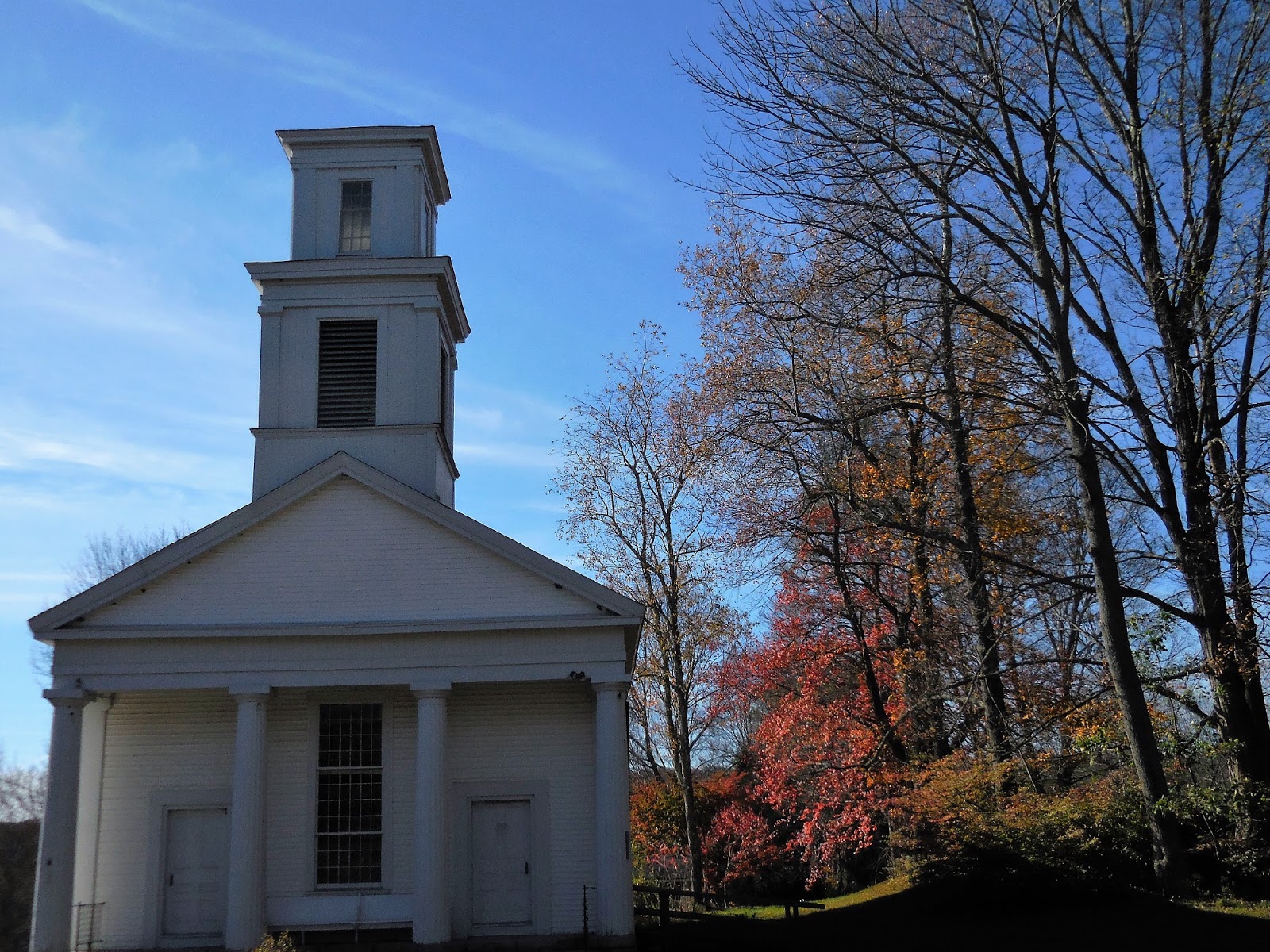
The disused but preserved church in the center of Westford, a few hundred yards from the foundations of the Westford Glass Co.
The October 2017 Heckler & Co. live auction.
We're entering a busy couple of weeks for specialist bottle auctions, with several online sales going on now or starting soon. Here in Connecticut, Norman C. Heckler & Co. just had one of their live auctions, where there was some good local antique glass up for bidding, including an amber Willington blueberry preserve bottle and a large, light yellow olive chestnut bottle (both at upper left in the auction floor photo). The blueberry bottle went for something approaching a retail price, but the chestnut was a bargain.

PATENT insulator, Willington Glass Co.
In November, Heckler's is having an online sale. One interesting Connecticut piece is an insulator embossed PATENT (with the letters reversed). There are two or three variants of this item, all thought to be made in Willington, with reports of shards being found at the glass factory site and also along railroad tracks in the area. Apparently, insulator collectors don't necessarily think that these were insulators, and there is some speculation that they were some kind of decorative architectural accent (whether or not a big pyramidal chunk of dark muddy olive glass with "PATENT" written backwards all over it in block letters is "decorative," is, I suppose, a matter of taste).

GI-33 WASHINGTON / JACKSON pint historical flask, Coventry Glass Works (left) with three GI-32 New England Washington flasks.
The sale preview also offered a chance to examine a somewhat confusing group of flasks, the GI-31, 32 and 33 Washington/Jackson pints. These are quite similar to each other, and I've seen well-known specialists mix them up. Of interest to the staff here at Quiet Corner Glass is the GI-33, which was the Coventry Glass Works version of this type of Washington flask. The easiest field mark of the 33 is that the lettering is noticeably smaller than with the other two molds, with the W in "Washington" being placed opposite G.W.'s receding hairline. In the 31 and 32 flasks, the W is down at eye level. GI-31 is probably a Keene-Marlboro St. (NH) flask, whereas GI-32 is of uncertain New England origin.

Sunday, May 21, 2017

Museum of Connecticut Glass 2017

Center of the National Historic Glass Factory District in Coventry, Ct: the old University of Connecticut agricultural experiment barn, the Capt. John Turner house (both MoCG property) and the Nathaniel Root house.

 The Museum of Connecticut Glass started their 2017 schedule of public events with the annual antique glass and bottle show. Tours were also offered of the John Turner house, which was built ca. 1812-1813 by one of the incorporators of the Coventry Glass Works.

The sales field at the Coventry glass show, May 20, 2017.
  In spite of some cool, cloudy weather with a few drops of rain for the first half of the show, there was a great selection of glass up for sale, and a decent turnout of buyers, though it possibly wasn't as busy as some other Coventry shows in recent years. There was a conflict with another area glass sale, which probably didn't help, at least from the seller's point of view.

Stoneware, case bottles and more on offer.

Some of the good stuff: Willington, Westford and New London flasks.

A Coventry DEWITT CLINTON / LAFAYETTE half pint historical flask, GI-81.

There weren't many New England Pitkin flasks available at the show this year, but in June there will be a chance to check out one of the best collections of Pitkin flasks anywhere...

Connecticut or New England Pitkin-type flasks. 

Next month's Museum activity will be a display of Pitkin-type flasks and related early American glass, with expert Dana Charlton-Zarro on hand to share her knowledge of the subject. This will, I believe, be the first time that Dana has traveled to the Pitkin homeland in Connecticut to give a public talk about her favorite antique bottles, and it should be a special opportunity to see and learn about a beautiful and widely admired class of early glassware. The Pitkin display will be held Saturday, June 17, 1:00-4:00 at the Museum of Connecticut Glass.

Future MoCG open houses will be held the third Saturday of each month, 1:00-4:00, through the autumn. Special exhibits will include:
• July 15 - Victorian glass tableware manufacture in Connecticut, with Nick Wrobleski (tentative).
• August 19 - Coventry Glass Works flasks and other antique Connecticut blown-in-mold glass.
• September 16 - early Connecticut freeblown and pattern-molded tableware, whimsies and other rarities, with Tom Marshall.
• October 21 - TBA.

Sunday, June 14, 2015

Awesome Seventeen-Eighties Work Escape Wayback Weekend

The Pitkin Glass Works ruins.
 The 1783~1830 Pitkin Glass Works ruins were open to the public this weekend, in conjunction with Manchester Pride Week and the Connecticut tourism open house day. It was a rare chance to see the ruins up close, although they are located in a residential neighborhood and can be viewed from the street over a fence at any time. The Pitkin factory is the oldest of Connecticut's glass works, and also, by some fluke of history, the only early Connecticut glass factory where significant portions of the factory building itself are still standing (there are still some visible foundations at the site of the Westford Glass Company, but all of the other factories have been completely leveled).

Waste glass drips and broken bottles in a bald spot in the lawn on the Pitkin grounds. The glass is mostly olive-green-amber, but notice the two light blue-green shards at center, examples of an uncommon but legitimate Pitkin color.
Even on the surface of the soil around the ruins there are occasional pieces of glass and other factory waste. Early glass works were pretty messy affairs, apparently, and Pitkin debris can be found all around the area. Several neighbors stopped in during the open house to talk to the staff of the Manchester Historical Society and donate pieces of glass that they had unearthed when gardening or having old oil tanks removed.

Excavations inside the walls of the factory ruins, with some possible foundation stones exposed.
A number of archaeological digs have been conducted at the Pitkin Glass Works, including extensive investigations by Fredrick Warner and his students from Central Connecticut State University in 1984 (summarized in A History of the Pitkin Glass Works by William E. Buckley), as well as more recent and ongoing excavations carried out by Manchester middle school students.

Stones and old bricks exposed by school group excavations.
The walls of the Pitkin factory building are primarily made of grey gneiss. The local bedrock in most of Manchester is Triassic sedimentary "red beds" and basalt, so construction materials were probably carted in, perhaps from the quarries at Bolton Notch, east of Manchester.

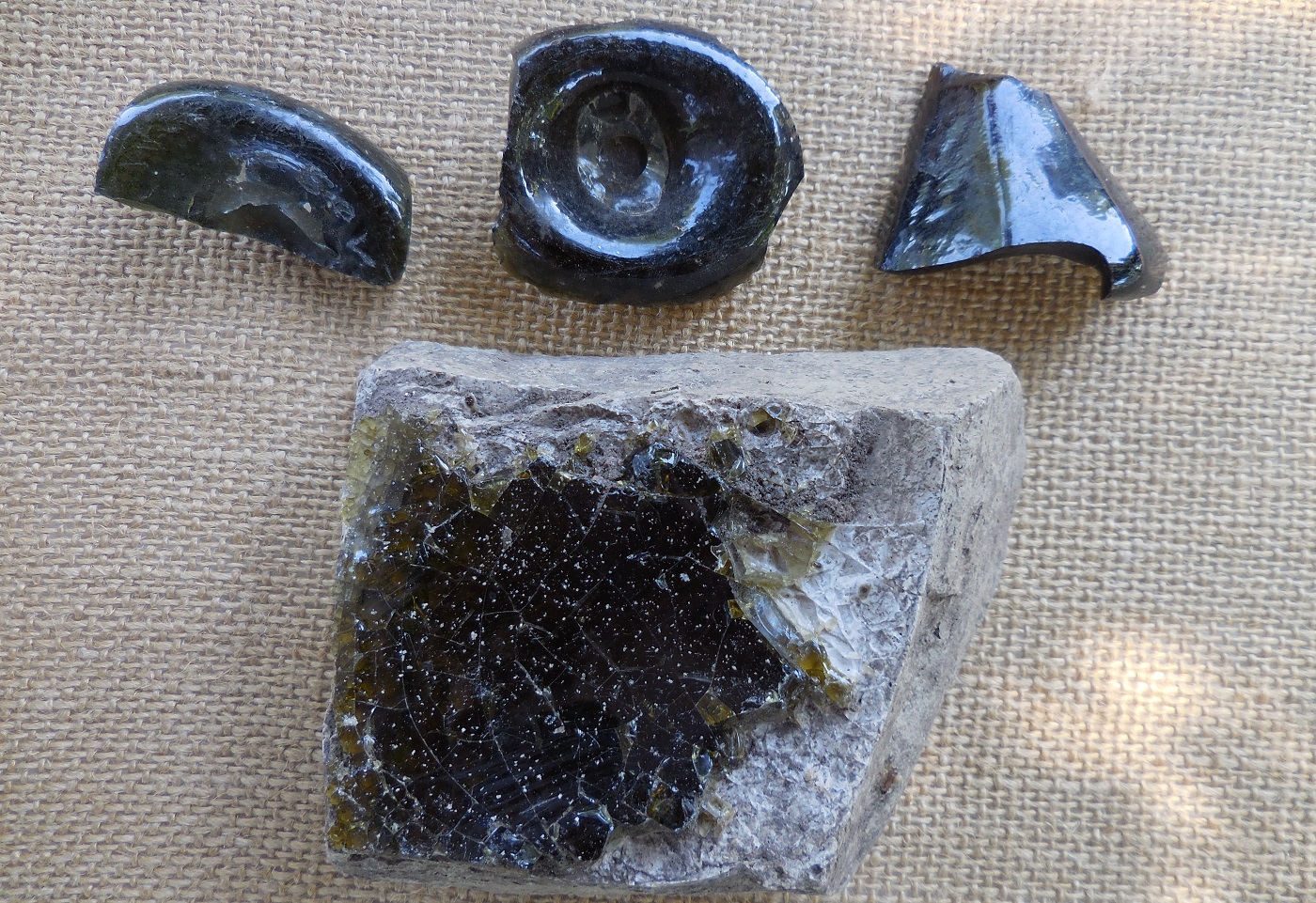
Artifacts excavated at the Pitkin site by Tom Duff. Two pontiled bases of Pitkin-type pattern molded flasks in olive green; the side of an umbrella inkwell in dark olive amber; and a large fragment of a ceramic pot for melting glass.
Archaeological excavations at glass factory sites provide some of the strongest evidence for attributing particular products to a given glass works. Pitkin-type flasks, with swirled or broken swirl pattern-molded embossings and blown in the German half-post method, are indeed fairly abundantly represented among shards from the Pitkin Glass Works. Extremely similar flasks were also blown at other contemporaneous New England glass works, however. Tom Duff has an interesting shard in his collection of Pitkin materials, picked up near the ruins many years ago, that is clearly from a Coventry Lafayette figured flask. Glass factories incorporate old broken glass, or cullet, into new batches to hasten melting, so the Lafayette shard was probably left behind from a pile of broken bottles collected from the community for recycling. Care must be taken when interpreting finds from factory sites; clear patterns certainly emerge and provide solid links between certain types of bottles and certain factories where multiple fragments of those bottles have been recovered, but odd one-off shards could be misleading.

Tom Duff's display of glass factory tools and New England bottles representative of the likely products of the Pitkin Glass Works.
Representatives of the Manchester Historical Society and the Pitkin Glass Works organization were on hand to answer questions, with displays of bottles and other artifacts. Tom Duff brought in Pitkin-type flasks and inkwells, as well as figured flasks, case gin bottles and other glassware typical of the goods that were likely produced by Pitkin. He also had blow pipes and other glass house tools, including a ribbed iron mold used to make pattern molded glass, along with a modern teal-colored Pitkin-type flask blown in his mold by Pairpoint Glass on Cape Cod. The 32 rib mold was recovered from a warehouse in New Jersey, but could conceivably be an eighteenth or early nineteenth century antique from New England.