Showing posts with label end-of-day. Show all posts

Saturday, September 16, 2017

Early Glass at the MoCG

Free blown and dip mold glassware in the Marshall collection.
 The September open house at the Museum of Connecticut Glass featured a display by Tom Marshall, who specializes in unusual and early free blown, dip molded and pattern molded glass, of the type that could have been made by the eighteenth and early nineteenth century glass works of Eastern Connecticut. Many Museum regulars turned out to admire some spectacular antique bottles and tableware, and there was also a slow but steady stream of visitors from the general public.

Crude free blown inkwell, bottles and tableware.

Pattern molded corner, with Pitkin-type flasks, inkwell, and an extremely rare Pitkin hat (likely a salt cellar, or possibly a whimsey).

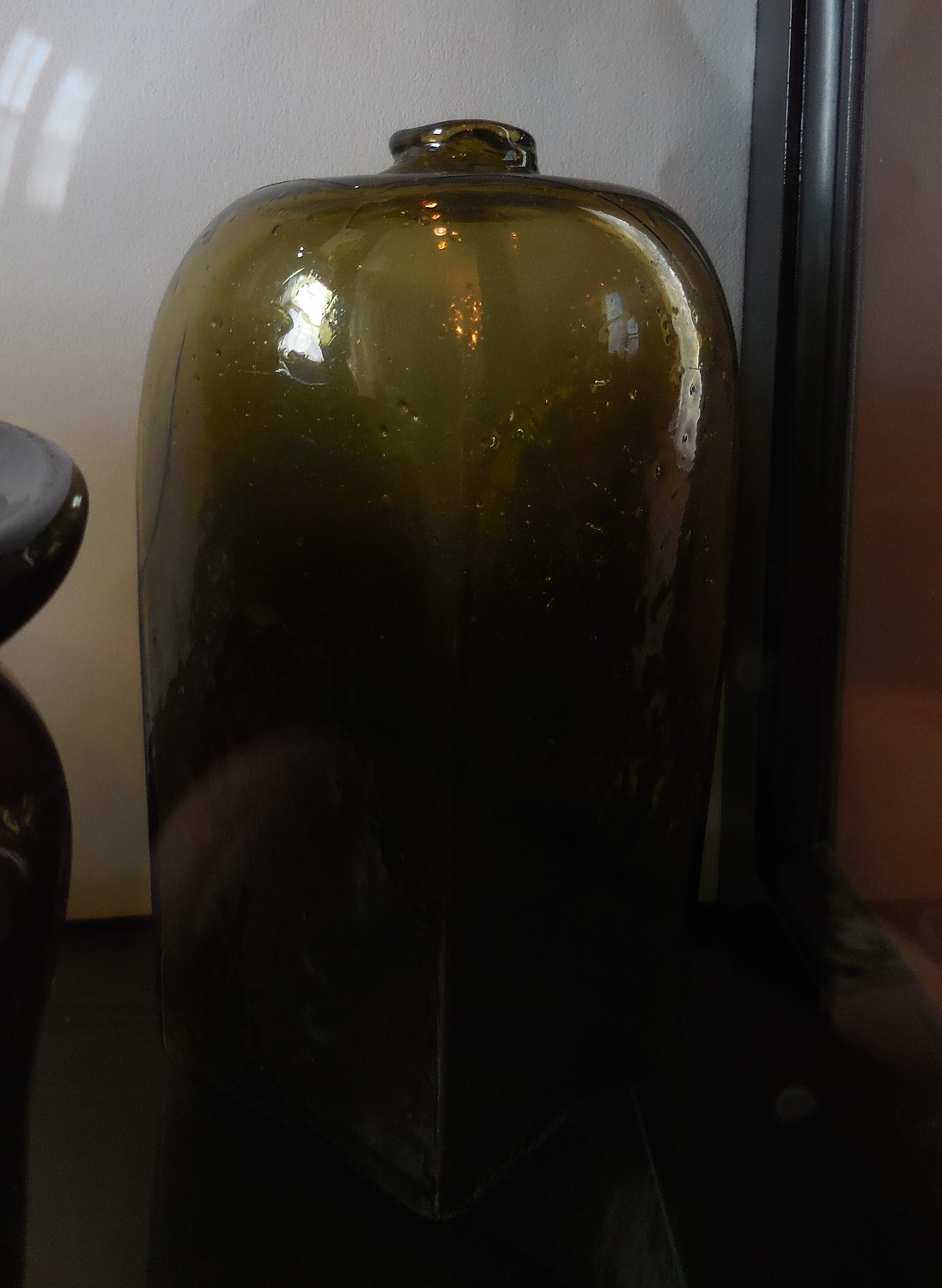
Early, flat-bottomed case-gin bottle whatzit with a plain sheared lip. Smaller than the common Continental case gins, in a more Connecticut-ish or New England-y glass color, with a very rare mouth treatment for this sort of bottle.

Large (baseball-sized) free blown inkwell.

"Coventry Glass Works" sign, likely not period.
Aside from the special glass from Tom Marshall, the Museum had a recent acquisition on display: a large blue painted wooden sign reading "Coventry Glass Works." This doesn't look all that old to me; it's pretty clean and the blocky sans-serif lettering looks kind of modern. Others who have examined the sign are also of the opinion that it's a twentieth century fantasy reproduction, not something that was ever hung outside the factory 200 years ago. Apparently a similar (also possibly not authentic) sign exists for the Willington Glass Co., in a private collection in the area.

Monday, August 15, 2016

A Unique Bottle from Coventry


The Connecticut Historical Society has a collection of interesting bottles, glassware and related artifacts from the state's eighteenth and nineteenth century glass works, and one of the most important glass objects in their archive is a heavy, clear olive-green freeblown bottle thought to have been made at the Coventry Glass Works. This "pinch bottle" is roughly square in cross section, pinched to fuse opposite walls of the bottle together and create wavy internal tubes at each corner, between upper and lower chambers, and two more tubes in the wall at the center of the bottle. The center tubes are narrow, and one of them looks like it might not be open all the way through. This style of bottle is known from European glass houses, but as an American and Connecticut product, this specimen is probably unique.


The Coventry pinch bottle is illustrated in American Glass (George and Helen McKearin, 1948) and in American Bottles & Flasks and Their Ancestry (Helen McKearin and Kenneth Wilson, 1978). McKearin and Wilson report that bottle was recovered in the Coventry area around the time of World War I, and that it matches the description of a Coventry bottle said by Edwin Atlee Barber to have been owned by Nathaniel Root, son of the first agent of the Coventry Glass Works.


An old collector's label has the inscrutable legend: B3 ARR #7 R.11.BB. I wonder if anyone still knows what any of that means?


The lip is also peculiar for an early American bottle: sheared and tooled into an outward flare, without any applied glass. The contexts where one does see similar lip treatments is early decanters (which is, I would imagine, how this particular object was used), and nineteenth century cologne bottles.


The flattened base of the probable decanter is also highly unusual, with a deeply impressed, cross-shaped pontil mark. The interior of the impression is surprisingly smooth, with only a couple of small patches of broken glass adhering from the pontil rod. Also visible in this view is a crack that traverses the bottom of the bottle and extends part way up one side.


The Coventry pinch bottle is a crudely beautiful example of the glassblower's art, and a remarkable survival from the golden age of American glass making.

Sunday, June 21, 2015

Museum of Connecticut Glass Open House

Free blown and dip mold New England glass.

 The Museum of Connecticut Glass held one of its monthly open houses this weekend. The Museum has a very limited, all-volunteer staff, but they are trying to have regular public educational events and shows during the warmer months. The main event for June was a spectacular display of early glassware and bottles from the collection of Tom Marshal. Tom has been acquiring his glass since the 1980s, and focuses on primitive free blown bottles and tableware, particularly forms and colors that can be associated with Connecticut, or at least the general New England area. Many of these objects are quite unusual and rare, and it was a treat to see so many in one place. Tom and other Museum volunteers gave informative talks about antique glass and glassmaking, and there was also a bottle sales area set up to benefit the Museum.


Bruce Mitchell and Alan Lagocki talk about glass making and early glass factories in Connecticut in the Museum's barn display area. The famous $3 bottle tables are by the window, with some real bargains to be had.

More of Tom Marshal's pre-1840 Connecticut-ish tableware, utilities and unique "end-of-day" items, in the kitchen window of the Capt. John Turner house.


A small display of later 19th and early 20th Century decorative glass, mostly made by the Meriden Flint Glass Company, from Bruce Mitchell's collection.

Freeblown and pattern molded inkwells, attributable to the Pitkin Glass Works or possibly other contemporaneous Connecticut factories. The "Pitkin hat" at left is a bit cracked, but one of the few known examples of an exceedingly rare and desirable end-of-day type item.